The SFFaudio Podcast #222 – READALONG: Nineteen Eighty-Four by George Orwell

Podcast

The SFFaudio PodcastThe SFFaudio Podcast #222 – Jesse, Jenny, Paul Weimer and Bryan Alexander discuss Nineteen Eighty-Four by George Orwell.

Talked about on today’s show:
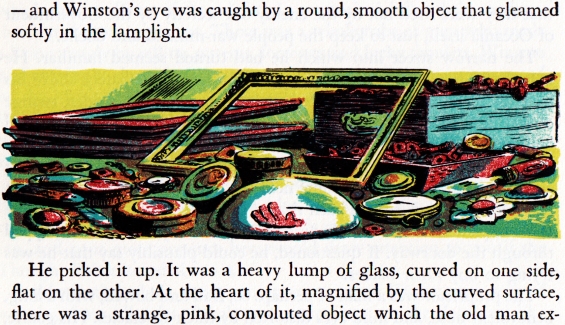
The audiobook, Recorded Books, the appendix, The Lord Of The Rings, the feeling in your right hand, a dream-like book, Room 101, a disjointing of time, Infinite Jest by David Foster Wallace, Signet Classic, already a member of the Junior Anti-Sex League at 12, a 1971 sex drive, memory, Winston Smith’s obsession with the past, the three traitors, the Soviet Union as applied to Britain, show trials, it is so effective, The Running Man is a prole version of Nineteen Eighty-Four, “WHITMAN, PRICE, AND HADDAD!!! You remember them! There they are now, BASKING under the Maui sun.”, down the memory hole, the brutality of the movies and the applause of the audience, the crushing of weakness, the terrible children, the 1954 BBC TV version starring Peter Cushing, Winston’s own memories of his childhood, did Winston kill his sister, his bowels turn to water when he see a rat, the return of the mother, a bag of decay, the 1984 version of 1984, John Hurt looks like he was born to play Winston Smith, is it Science Fiction?, dystopia, does this feel like Science Fiction?, Social Science Fiction, If This Goes On… by Robert A. Heinlein, Animal Farm, Goldstein’s Book, the re-writing of history, collapsing the vocab, The Languages Of Pao by Jack Vance, Babel-17 by Samuel R. Delany, The Embedding by Ian Watson, Isaac Asimov’s review of Nineteen Eighty-Four, Orwell imagines no new vices, WWIII, in regular SF we get used to a lack of motifs, the coral, the memories, the place with no darkness, everything is recycled in a dream and people merge, in dream logic 2+2 can equal 5, reduction of the world and the self, Brave New World by Aldous Huxley, soma, The Hunger Games, Wool by Hugh Howey, cleaning day, grease, transformed language, a crudboard box, euphony, a greasy world, a comparison to We by Yevgeny Zamyatin, We The Living by Ayn Rand, Harcourt Brace, Politics And The English Language by George Orwell, V For Vendetta, Norsefire vs. IngSoc, a circuitous publishing history, crudpaper, prole dialect, part dialect, New Speak, military language, Generation Kill, military language is bureaucratic language, Dune by Frank Herbert, Battle Language, private language, Brazil, the thirteen’s hour, The Canterbury Tales by Geoffrey Chaucer, victory means shit, Airstrip One, speakwrite, Star Wars, careful worlding, a masterwork, a transformation and an inoculation, watch 1984 on your phone while the NSA watches you watch it, North Korea, “without getting to political”, 2600‘s editor is Emmanuel Goldstein, the traitor Snowden, that’s what this book is, it’s political, The Lives Of Others, hyper-competent, the bedroom scene, “We are the dead.”, how did the picture break off the wall, dream-logic, Jesse knows when he’s dreaming, if you dream a book you must generate the text, dreaming of books that don’t exist, a great sequel to Ringworld?, The Sandman, “We shall meet in the place where there is no darkness.”, O’Brien, Martin, the worst thing is you can’t control what you say when your sleeping, uncanny valley,

Whatever it was, you could be certain that every word of it was pure orthodoxy, pure IngSoc. As he watched the eyeless face with the jaw moving rapidly up and down, Winston had a curious feeling that this was not a real human being but some kind of dummy. It was not the man’s brain that was speaking, it was
his larynx. The stuff that was coming out of him consisted of words, but it was not speech in the true sense: it was a noise uttered in unconsciousness, like the quacking of a duck.

Polar Express, the book within the book, high end books, Fahrenheit 451 by Ray Bradbury, is London the capital of Oceania?, the value of the book, Stephen Fry’s character, a book that tells you only things you already knew, The Man In The High Castle by Philip K. Dick, the possibilities of other books, supercharged moments in movies, Twelve Monkeys, Dark City, Book Of Dreams, utopias within dystopias, reading in comfort and safety, the golden place, Julia is a pornosec writer, Robert Silverberg, Lawrence Block, Donald E. Westlake, Marion Zimmer Bradley, The Processed Word by John Varley, Russian humor, is there really a war?, power is the power to change reality, Stephen Colbert’s truthiness, doublethinking it, the proles seem to be happier, feeling contempt, lottery tickets depress Jesse, “renting the dream”, the proles are obsessed by lotteries, who is the newspaper for?, the chocolate ration, Larry Gonick’s The Cartoon History Of The Universe, how stable is Oceania?, guys and Guy, how stable is North Korea?, Christopher Hitchens, there’s no hope in 1984, the subversion mechanism has been subverted, changing human behavior, Walden Two by B.F. Skinner, Faith Of Our Fathers by Philip K. Dick, genocide, racial purity, are they bombing themselves?, where does Julia get all her treats?, utopia is a nice cup of coffee, The Principle Of Hope by Ernst Bloch, what’s missing from your life comrade?, is Julia playing a role?, she’s the catalyst for everything, misogyny vs. misanthropy, Nietzsche’s master morality slave morality, political excitement is transformed into sexual excitement, ‘I have a real body it occupies space (no you don’t you’re a fictional character)’, Julia’s punk aesthetic, I love you., she’s the dream girl, the romantic couple that brings down the bad order, The Revolt Of Islam by Percy Bysshe Shelley, Pacific Rim, The Matrix, Equilibrium, Mephistopheles, Mustapha Mond, Jesse thought she was in on it, the prole lady out the window, nature, ragged leafless shrubs, nature has been killed, the Byzantine Empire, the Catholic Church, cult of personality vs. an idoru Big Brother, Eurythmics, we’re nostalgic for the Cold War, the now iconic ironic 1984 Apple commercial, dems repubs NSA, has Britain been secretly controlling the world using America?, George Bernard Shaw, society and politics, SF about the Vietnam War, petition for and against the war, Judith Merril, The Forever War by Joe Haldeman, The Handmaid’s Tale by Margaret Atwood, China.

Nineteen Eighty-Four by George Orwell

Nineteen Eighty-Four by George Orwell

Reader's Digest 1984

Reader's Digest 1984

Reader's Digest 1984

Reader's Digest 1984

Reader's Digest 1984

Mori's 1984

Posted by Jesse Willis

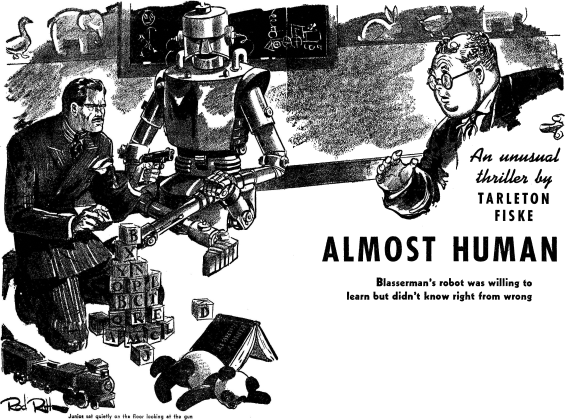
Dimension X: Almost Human adapted from a story by Robert Bloch

SFFaudio Online Audio

Almost Human illustrated by Rod Ruth

This is a truly terrible story, by someone who is normally perceived to be a great author, Robert Bloch. I suspect Bloch chose the pseudonym for this one because it is so bad. Indeed, I suspect this is precisely the kind of story Isaac Asimov was trying to defeat with his Three Laws of Robotics. But beyond the dangerous robot trope it also features, at least to my ears, the most creepily lascivious robot ever!

Junior is oily, immoral, and oversexed.

Ewww!

Dimension XDimension X – Almost Human
Adapted from the story by Robert Bloch; Adapted by George Lefferts; Performed by a full cast
1 |MP3| – Approx. 29 Minutes [RADIO DRAMA]
Broadcaster: NBC
Broadcast: May 13, 1950
A gun moll answers an ad to be a nursemaid to a baby robot, things are fine until her boyfriend, a professional thief, shows up and teaches the robot a few things. First published in Fantastic Adventures, June 1943.

UPDATE:
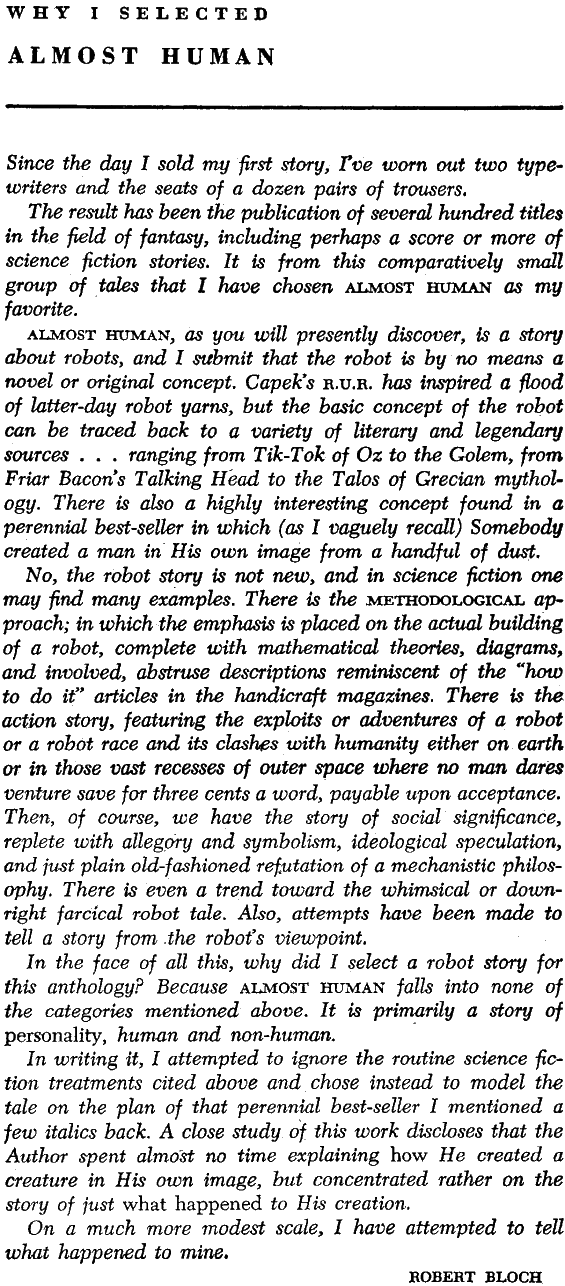
Here’s Robert Bloch’s introductory essay to Almost Human (as written for My Best Science Fiction Story a 1949 anthology edited by Leo Margulies and Oscar J. Friend):

Robert Bloch - "My Best Science Fiction Story" - Almost Human

Posted by Jesse Willis

Fantastic Imaginings, edited by Stefan Rudnicki

SFFaudio Recent Arrivals

Audio Anthology - Fantastic Imaginings, edited by Stefan Rudnicki

Just in, this very interesting anthology, edited by Stefan Rudnicki! I couldn’t find a Table of Contents on this package or on the Audible site, so I included it below. Why don’t audio publishers find the Table of Contents important when it comes to anthologies and collections? Because… THEY ARE.

After seeing the contents, I’m eager to dive into this. Oliver Onions, Guy de Maupassant, Harlan Ellison, John Crowley… Harlan Ellison reading John Crowley… this is terrific!

TABLE OF CONTENTS
INTRODUCTION
Lofty Ambitions by Harlan Ellison, read by Harlan Ellison

PART 1: THE MYTHS WE LIVE BY
A Youth In Apparel That Glittered by Stephen Crane, read by Stefan Rudnicki (poem)
After the Myths Went Home by Robert Silverberg, read by Stefan Rudnicki
Novelty by John Crowley, read by Harlan Ellison
Pan And The Firebird by Sam M. Steward, read by Stefan Rudnicki
Murderer, The Hope Of All Women by Oskar Kokoschka, performed by cast
The Touch Of Pan by Algernon Blackwood, read by Stefan Rudnicki
The Lost Thyrsis by Oliver Onions, read by Roz Landor
The Bacchae (excerpt) by Eurpides, performed by cast

PART 2: MYTHS THAT BITE
A Noiseless Patient Spider by Walt Whitman, read by Stefan Rudnicki
Mystery Train by Lewis Shiner, read by John Rubenstein
Continued On The Next Rock by R.A. Lafferty, read by Stefan Rudnicki
Diary Of A God by Barry Pain, read by Enn Reitel
The Repairer of Reputations (excerpt) by Robert W. Chambers, read by Stefan Rudnicki
The Yellow Sign by Robert W. Chambers, read by Stefan Rudnicki
An Inhabitant Of Carcosa by Ambrose Bierce, read by Danny Campbell
The Horla by Guy de Maupassant, read by Arte Johnson

PART 3: SHOCKING FUTURES
Kubla Khan by Samuel Taylor Coleridge, read by Stefan Rudnicki (poem)
City Come A’Walkin (excerpt) by John Shirley, read by Don Leslie
A Pail Of Air by Fritz Leiber, read by Stefan Rudnicki
The Machine Stops (excerpt) by E.M. Forster, read by Roz Landor
Looking Backward and Equality (excerpts) by Edward Bellamy, read by David Birney
Gulliver’s Travels (excerpt) by Jonathan Swift read by Scott Brick
Utopia (excerpt) by Sir Thomas More, read byChristopher Cazanove
Monument To Amun by Queen Hatshepsut, read by Judy Young

PART 4: TRAVELING FOOLS
La Bateau Ivre by Arthur Rimbaud, read by Stefan Rudnicki
Inspiration by Ben Bova, read by Stefan Rudnicki
The Bones Do Lie by Anne McCaffrey, read by Stefan Rudnicki
A Princess Of Mars (excerpt) by Edgar Rice Burroughs, read by John Rubinstein
The Great Stone Of Sardis (excerpt) by Frank R. Stockton, read by David Birney
Alice’s Adventures In Wonderland (excerpt) by Lewis Carroll, read by Michael York
Diary Of A Madman (excerpt) by Nicolai Gogol, read by Stefan Rudnicki
The Inferno (excerpt) by Dante, read by Stefan Rudnicki
The Odyssey of Homer (excerpt), read by David Birney

PART 5: TRANSFORMERS
The Stolen Child by William B. Yeats, read by Stefan Rudnicki
The Porcelain Salamander by Orson Scott Card, read by Gabrielle de Cuir
Let’s Get Together by Isaac Asimov, read by Arte Johnson
Dracula (excerpt) by Bram Stoker, read by Simon Vance
Dr. Jekyll And Mr. Hyde (excerpt) by Robert Louis Stevenson, read by John Lee
Goblin Market by Christina Rossetti, read by Gabrielle de Cuir
Frankenstein (excerpt) by Mary Shelley, read by Stefan Rudnicki0\ *
The Laidly Worm of Spindleston Heugh (Traditional English Fairy Tale), read by Judy Young
A Midsummer Night’s Dream (excerpt) by William Shakespeare, performed by cast
The Ballad of Tam Lin (Celtic ballad), read by Stefan Rudnicki
Metamorphosis (excerpt) by Ovid, read by Cassandra Campbell

PART 6: REST IN PIECES
Hearse Song
The Conqueror Worm by Edgar Allan Poe, read by Stefan Rudnicki
The New Testament: Revelations (excerpt), read by Stefan Rudnicki
The Colloquy of Monos & Una by Edgar Allan Poe, read by Stefan Rudnicki and Gabrielle de Cuir
From the Crypts of Memory by Clark Ashton Smith, read by Danny Campbell
The Comet by W.E.B. DuBois, read by Mirron Willis
Sand (excerpt) by Stefan Rudnicki, performed by cast
Transience by Arthur C. Clarke, read by Bahni Turpin
The Illusionist by Gareth Owen, read by Stefan Rudnicki
Unchosen Love by Ursula K. LeGuin, read by Stefan Rudnicki
In Lonely Lands by Harlan Ellison, read by Harlan Ellison
News from Nowhere (excerpt) by William Morris, read by Stefan Rudnicki

PART 7: COMMENTARIES
The Special And General Joys of Science Fiction by Ben Bova, read by Stefan Rudnicki
Edgar Allan Poe 1809-1849 by Elliott Engel, read by Gabrielle de Cuir
Adolescence And Adulthood In Science Fiction by Orson Scott Card, read by Stefan Rudnicki

Posted by Scott D. Danielson

Commentary: The Adventure Of The Mysterious Sherlock Holmes Audio Dramas In The Thrift Store

Aural Noir: Recent Arrivals

I had an exciting Friday a few months back. I’m calling the events of June 1st, 2012 The Adventure Of The Mysterious Sherlock Holmes Audio Dramas In The Thrift Store

The story begins with me visiting a thrift store. I first found this vintage 1975 box of Lego (with the original Woolco price tag still on the box) – I got it for just $4. Then I picked up a $2 game called Isaac Asimov Presents Waddington’s SUPERQUIZ.

Then, in the audiobook section I spotted three two-cassette collections for $4 each.

And they turned out to be the big winner.

Entitled simply “The Sherlock Homes Collection“, at first I thought they were audiobooks, something I’ve seen many times before. But the price stickers obscured the details. Then was a shock, an instant of recognition for the actor pictured on the back covers was none other than Roy Marsden of The Sandbaggers fame – I covertly peeled back one of the stickers and investigated further.

They were audio dramas!

According to Grant Eustace’s website (he adapted them) only 6 of the 24 dramatizations produced were broadcast (on BBC World Service). But that may not mean they were no well received as it appears that they were actually produced for British Airways in-flight audio entertainment. One thing seems clear, I didn’t know they had even existed before that Friday, and I think that probably meant they wer’e not very well known.

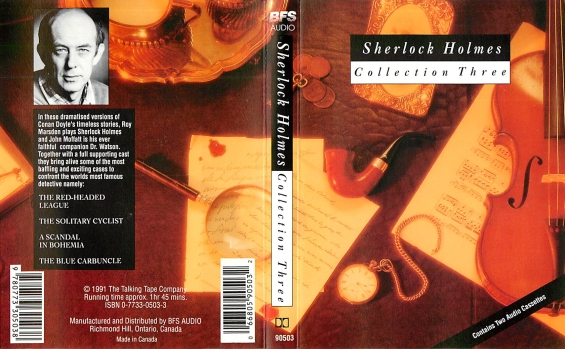
I got “Collection Three” (ISBN: 0773305033) which features adaptations of:

The Red Headed League
The Solitary Cyclist
A Scandal In Bohemia
The Blue Carbuncle

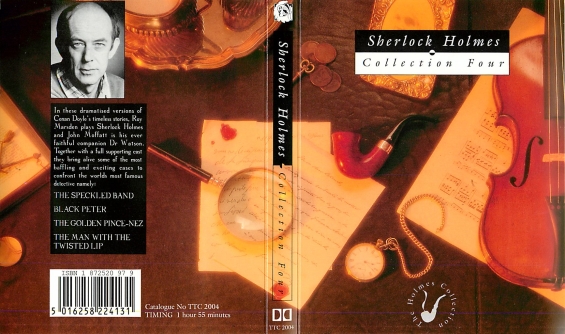
“Collection Four” (ISBN: 0773305041) which features adaptations of:
The Speckled Band
Black Peter
The Golden Prince-Nez
The Man With The Twisted Lip

And “Collection Six” (ISBN: 0773305068) which features adaptations of:
The Devil’s Foot
The Bruce Partington Plans
The Cardboard Box
Thor Bridge

There are two different companies credited with publication, BFS Audio (and BFS Entertainment is still in business) and Talking Tape Company (which I have no data on). The tapes themselves all have the BFS Audio logo on them.

Here are the details:

Cover of Collection Three:
BFS Audio - Sherlock Holmes Collection Three

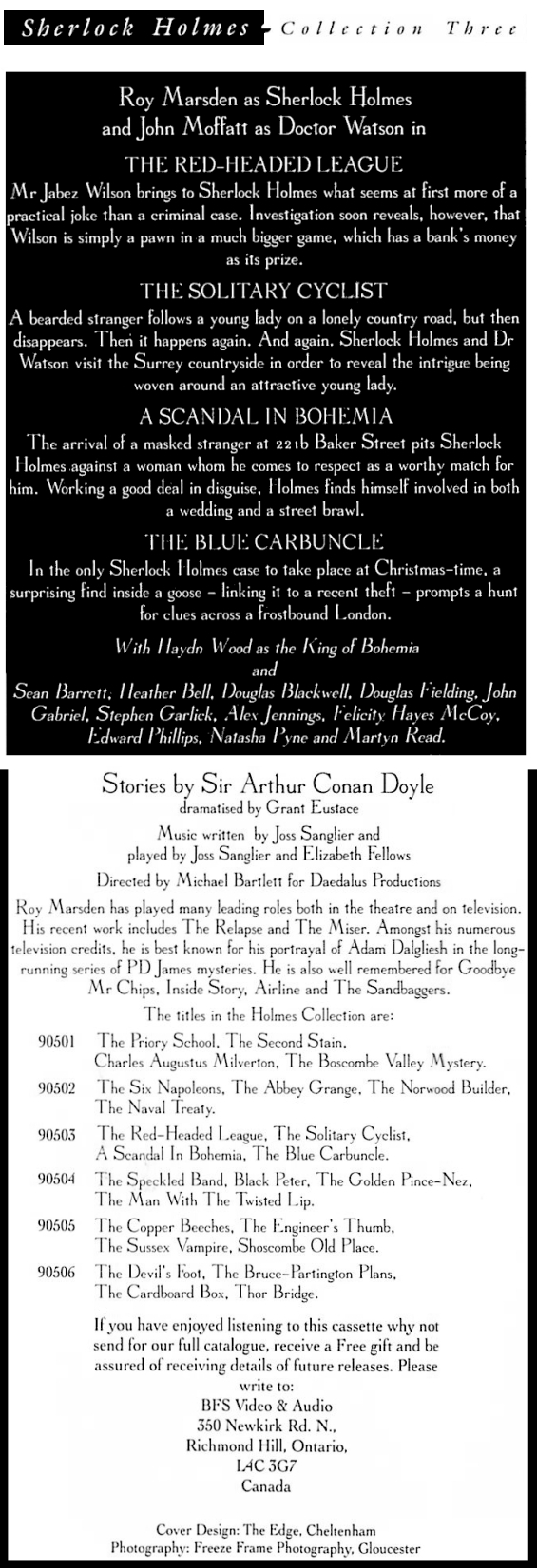
Interior details from Collection Three:
BFS Audio - Sherlock Holmes Collection Three - interior details

Cover of Collection Four:
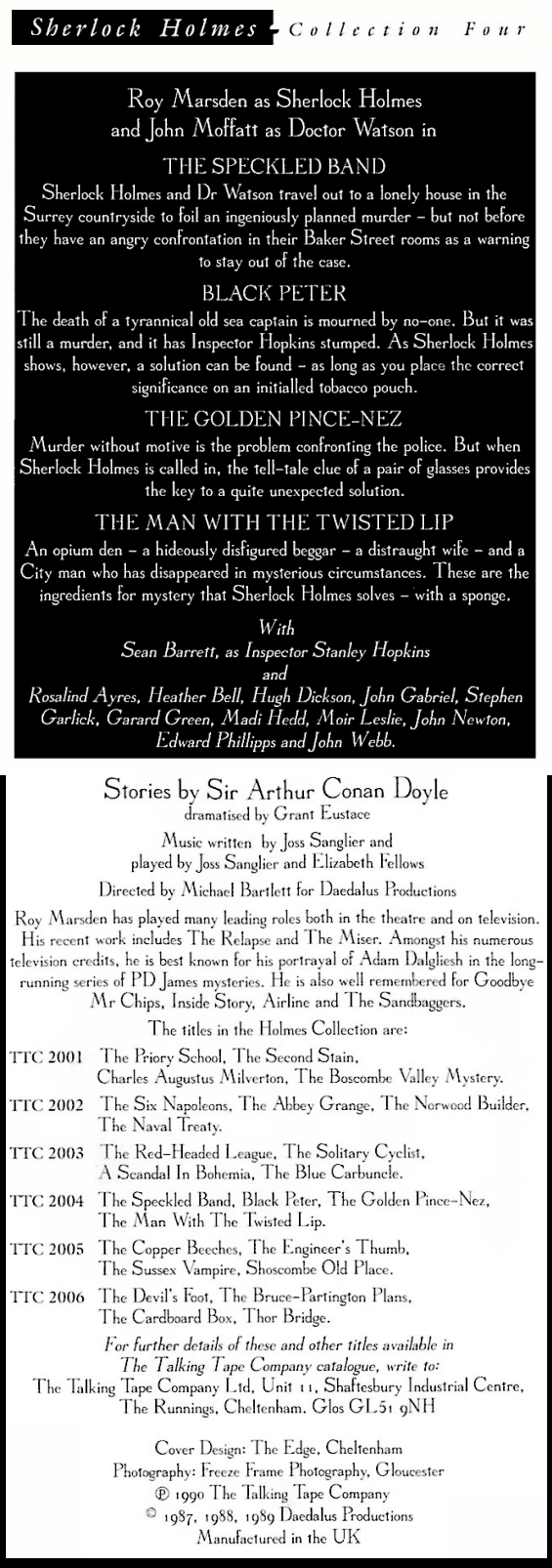
BFS Audio - Sherlock Holmes Collection Four

Interior details from Collection Four:
BFS Audio - Sherlock Holmes Collection Four - interior details

Cover of Collection Six:
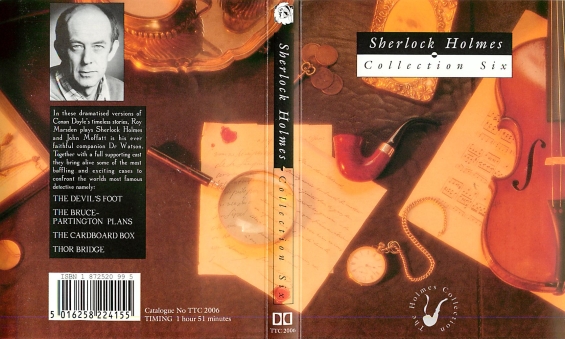
BFS Audio - Sherlock Holmes Collection Six

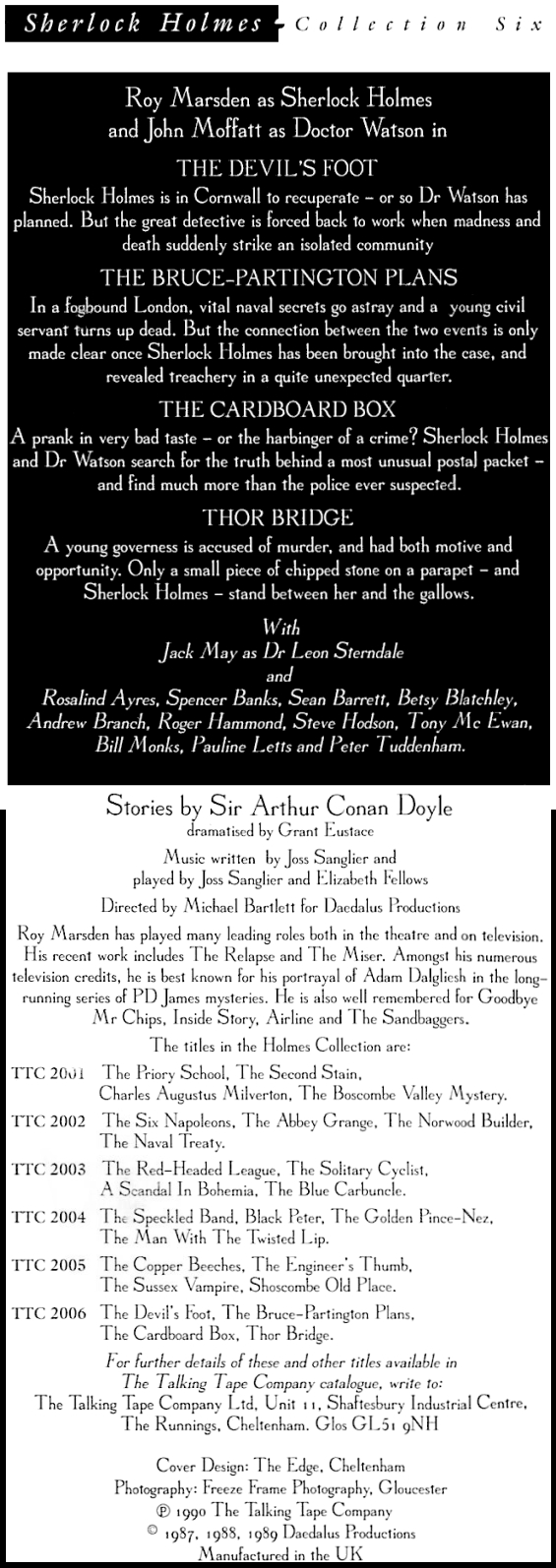
Interior details from Collection Six:
BFS Audio - Sherlock Holmes Collection Six - interior details

Now, after listening to the twelve dramas over the last few months I can happily report that these are really excellent productions. Very swift, but dialogue driven, with uniformly excellent acting.

If you’ve got a source that has the other three collections please let me, and everyone else, know by commenting. This series should be much better known.

Posted by Jesse Willis

Commentary: A “Top 100 Sci-Fi Audiobooks” List

SFFaudio Commentary

Sci-Fi ListsLast year somebody* pointed out that a list of “The Top 100 Sci-Fi Books” (as organized by the Sci-Fi Lists website) was almost entirely available in audiobook form!

At the time of his or her compiling 95 of the 100 books were available as audiobooks.

Today, it appears, that list is approaching 99% complete!

I’ve read a good number of the books and audiobooks listed, and while some of them are indeed excellent, I’d have to argue that some are merely ok, and that others are utterly atrocious.

That said, I do think it is interesting that almost all of them are available as audiobooks!

Here’s the list as it stood last year, plus my added notations on the status of the missing five:

01- Ender’s Game – Orson Scott Card – 1985
02- Dune – Frank Herbert – 1965
03- Foundation – Isaac Asimov – 1951
04- Hitchhiker’s Guide To The Galaxy – Douglas Adams – 1979
05- 1984 – George Orwell – 1949
06- Stranger In A Strange Land – Robert A Heinlein – 1961
07- Fahrenheit 451 – Ray Bradbury – 1954
08- 2001: A Space Odyssey – Arthur C Clarke – 1968
09- Starship Troopers – Robert A Heinlein – 1959
10- I, Robot – Isaac Asimov – 1950
11- Neuromancer – William Gibson – 1984
12- Do Androids Dream of Electric Sheep? – Philip K. Dick – 1968
13- Ringworld – Larry Niven – 1970
14- Rendezvous With Rama – Arthur C. Clarke – 1973
15- Hyperion – Dan Simmons – 1989
16- Brave New World – Aldous Huxley – 1932
17- The Time Machine – H.G. Wells – 1895
18- Childhood’s End – Arthur C. Clarke – 1954
19- The Moon Is A Harsh Mistress – Robert A. Heinlein – 1966
20- The War Of The Worlds – H.G. Wells – 1898
21- The Forever War – Joe Haldeman – 1974
22- The Martian Chronicles – Ray Bradbury – 1950
23- Slaughterhouse Five – Kurt Vonnegut – 1969
24- Snow Crash – Neal Stephenson – 1992
25- The Mote In God’s Eye – Larry Niven and Jerry Pournelle – 1975
26- The Left Hand Of Darkness – Ursula K. Le Guin – 1969
27- Speaker For The Dead – Orson Scott Card – 1986
28- Jurassic Park – Michael Crichton – 1990
29- The Man in the High Castle – Philip K. Dick – 1962
30- The Caves Of Steel – Isaac Asimov – 1954
31- The Stars My Destination – Alfred Bester – 1956
32- Gateway – Frederik Pohl – 1977
33- Lord Of Light – Roger Zelazny – 1967
34- Solaris – Stanisław Lem – 1961
35- 20,000 Leagues Under The Sea – Jules Verne – 1870
36- A Wrinkle In Time – Madeleine L’Engle – 1962
37- Cat’s Cradle – Kurt Vonnegut – 1963
38- Contact – Carl Sagan – 1985
39- The Andromeda Strain – Michael Crichton – 1969
40- The Gods Themselves – Isaac Asimov – 1972
41- A Fire Upon The Deep – Vernor Vinge – 1991
42- Cryptonomicon – Neal Stephenson – 1999
43- The Day of the Triffids – John Wyndham – 1951
44- UBIK – Philip K. Dick – 1969
45- Time Enough For Love – Robert A. Heinlein – 1973
46- A Clockwork Orange – Anthony Burgess – 1962
47- Red Mars – Kim Stanley Robinson – 1992
48- Flowers For Algernon – Daniel Keyes
49- A Canticle For Leibowitz – Walter M. Miller – 1959
50- The End of Eternity – Isaac Asimov – 1955
51- Battlefield Earth – L. Ron Hubbard – 1982
52- Frankenstein – Mary Shelley – 1818
53- Journey To The Center Of The Earth – Jules Verne – 1864
54- The Dispossessed – Ursula K. Le Guin – 1974
55- The Diamond Age – Neal Stephenson – 1995
56- The Player Of Games – Iain M. Banks – 1988
57- The Reality Dysfunction – Peter F. Hamilton – 1996
58- Startide Rising – David Brin – 1983
59- The Sirens Of Titan – Kurt Vonnegut – 1959
60- Eon – Greg Bear – 1985
61- Ender’s Shadow – Orson Scott Card – 1999
62- To Your Scattered Bodies Go – Philip Jose Farmer – 1971
63- A Scanner Darkly – Philip K. Dick – 1977
64- Lucifer’s Hammer – Larry Niven and Jerry Pournelle – 1977
65- The Handmaid’s Tale – Margaret Atwood – 1985
66- The City And The Stars – Arthur C Clark – 1956
67- The Stainless Steel Rat – Harry Harrison – 1961
68- The Demolished Man – Alfred Bester – 1953
69- The Shadow of the Torturer – Gene Wolfe – 1980
70- Sphere – Michael Crichton – 1987
71- The Door Into Summer – Robert .A Heinlein – 1957
72- The Three Stigmata Of Palmer Eldritch – Philip K. Dick – 1964
73- Revelation Space – Alastair Reynolds – 2000
74- Citizen Of The Galaxy – Robert A. Heinlein – 1957
75- Doomsday Book – Connie Willis – 1992
76- Ilium – Dan Simmons – 2003
77- The Invisible Man – H.G. Wells – 1897
78- Have Space-Suit Will Travel – Robert A. Heinlein – 1958
79- The Puppet Masters – Robert A. Heinlein – 1951
80- Out Of The Silent Planet – C.S. Lewis – 1938
81- A Princess of Mars – Edgar Rice Burroughs – 1912
82- The Lathe of Heaven – Ursula K. Le Guin – 1971
83- Use Of Weapons – Iain M. Banks – 1990
84- The Chrysalids – John Wyndham – 1955
85- Way Station – Clifford Simak – 1963
86- Flatland – Edwin A. Abbott – 1884
87- Altered Carbon – Richard Morgan – 2002
88- Old Man’s War – John Scalzi – 2005
89- COMING SOON (October 15, 2012)Roadside Picnic – Arkady and Boris Strugatsky – 1972
90- The Road – Cormac McCarthy – 2006
91- The Postman – David Brin – 1985
92- NEWLY AVAILABLEStand On Zanzibar – John Brunner – 1969
93- VALIS – Philip K. Dick – 1981
94- NEWLY AVAILABLE The Cyberiad: Fables for the Cybernetic Age – Stanisław Lem – 1974
95- NOT AVAILABLE AS AN AUDIOBOOK – Cities In Flight – James Blish – 1955
96- The Lost World – Sir Arthur Conan Doyle – 1912
97- The Many-Colored Land – Julian May – 1981
98- Gray Lensman – E.E. ‘Doc’ Smith – 1940
99- The Uplift War – David Brin – 1987
100- NEWLY AVAILABLEThe Forge Of God – Greg Bear – 1987

In case you were wondering, the list was compiled using the following criteria:

“A statistical survey of sci-fi literary awards, noted critics and popular polls. To qualify a book has to be generally regarded as science fiction by credible sources and/or recognised as having historical significance to the development of the genre. For books that are part of a series (with some notable exceptions) only the first book in the series is listed.”

The “Next 100”, as listed over on Sci-Fi Lists, has a lot of excellent novels and collections in it too, check that out HERE.

[*Thanks to “neil1966hardy” from ThePirateBay]

Posted by Jesse Willis

The SFFaudio Podcast #166 – TOPIC: SFF FORMS (Short Story, Novella, Novellete, Novel, Fix-up, Trilogy, World)

Podcast

The SFFaudio PodcastThe SFFaudio Podcast #166 – Jesse, Luke Burrage, and Eric S. Rabkin discuss, at length, the SFF FORMS (Short Story, Novella, Novellete, Novel, Fix-up, Trilogy, World). Here’s the premise:

Science Fiction Forms: Short Story, Novella, Fix-Up, Novel, Trilogy, and World. Respectively, they might be exemplified thus: Short Story (“Mars Is Heaven!“), Novella (“Flowers for Algernon“), Fix-Up (The Martian Chronicles, which contains a revised version of “Mars Is Heaven!” or The Seedling Stars, Accelerando, and Beggars In Spain, all of which began as novellas), Novel (originals, like 1984, and derivatives like Flowers for Algernon or Varley’s novel Millennium coming from his short story “Air Raid“), Trilogy (original Foundation series), World (the ultimate Foundation world or Heinlein’s Future History [shared with others] or Banks’s Culture or LeGuin’s Hainish series [created just for the authors, but let’s not forget about fan fiction]). What are the special challenges and rewards in reading and writing in these diverse forms? What special challenges or rewards attend on reusing material in another form? Is the formal plasticity of SF unique among literary genres?

Talked about on today’s show:
Eric’s suggestion, literature with a capital “L”, The Dead by James Joyce, The Portrait Of The Artist As A Young Man, Doomsday Book by Connie Willis, Luke’s Science Fiction Book Review Podcast, the format, the themes, the variability of short story form, the feghoot, Day Million by Frederik Pohl, Accelerando, Stories Of Your Life And Others by Ted Chiang, The Tower Of Babel, stripped away vs. embellished to the nth degree, Flowers For Algernon by Daniel Keyes, Understand by Ted Chiang, The Bells by Edgar Allan Poe, The Black Cat, fantasy, the unexplicit story, valid reactions, the etymology of “text”, Earth Abides by George R. Stewart, a persuasive existential journey, The Scarlet Plague by Jack London, San Fransisco, short stories as objects of frivolity or training, the brilliance of an idea is not always enough, a novel can act as a community to an individual, Fahrenheit 451 by Ray Bradbury vs. The Fireman by Ray Bradbury, is the novel inherently more participatory than a short story?, the failure of technology vs. the power of nature, The Masque Of The Red Death, teaching Science Fiction with short stories and novels, The Science Fiction Hall Of Fame (Volume 1), the composite novel, Winesburg, Ohio by Sherwood Anderson, A.E. van Vogt, the fix-up, The Martian Chronicles by Ray Bradbury, Accelerando by Charles Stross, Lobsters by Charles Stross, the cat changes function, “an intellectual framework”, Robert A. Heinlein’s future history, the composite novel, Isaac Asimov, future history vs. psychohistory, Michael Moorcock, I, Robot, Robbie, the three laws, Stephen Byerly and Susan Calvin, unAsimovian assumptions, the full dose of SF, Reason, The Evitable Conflict, is Stephen Byerly a robot or a man?, the Mérode Altarpiece (a medieval iconographic trope), art history, Luke doesn’t think Asimov is that clever, R. Daneel Olivaw, the three laws are fairytale laws, positronic brains are positive, the three laws are for people (not just robots), The Bicentennial Man, Asimov’s powers, Asimov’s business acumen, Brandon Sanderson, shared worlds, gods, Mormonism, Daniel Clowes, The Death Ray, Elantris, “The Alexandria Quartet” by Lawrence Durrell, reading The Martian Chronicles backwards, Luke’s fiction, Alastair Reynolds, Sherlock Holmes, Baker Street Irregulars, whodunit ain’t the attraction, The Adventure Of The Speckled Band, a matter of cutting, A Clockwork Orange, it’s better without the extra chapter, the commercial effect (or the effect of commercialism), popular literature, the flabby novel, Robert J. Sawyer, Hominids, Calculating God, William Shakespeare, The Royal Ontario Museum, horse evolution, God needs a starship!?, where to find a paleontologist, “a hundred pages of nothing happening”, a circular argument, writing to the story’s demands, Kevin J. Anderson, commercial constraints shouldn’t be points of pride, the thickness of books, The Lord Of The Rings, does more succinct = more better?, novellas are novels with threads missing?, The Hobbit, the ambition of the author, Luke is rejecting the basic premise, The Stand by Stephen King, is it a better story short or long?, changes and updates and additional material, don’t let Asimov near a typewriter unless you want something written, Against The Fall Of Night by Arthur C. Clarke, The City And The Stars, expanding everything, Monster Story, “it came to me in a dream”, Minding Tomorrow, Nightfall (the short story) vs. Nightfall (the novel), “it’s a lot like a perfectly nice novel that eventually becomes a masterpiece”, The Lion of Comarre, it’s not a commercial podcast, a civil rowdiness, Eric’s Coursera course: Fantasy and Science Fiction: The Human Mind, Our Modern World, rechunking, forums, essays, 18,000 registered students, University of Michigan, only the competitors are qualified to judge the competitors, a history of the U.S. Civil War, Luke’s kitchen, grades, “there is no absolute abstract grade for anything”, Science Fiction and Politics (Courtney Brown), the governor of a steam engine, Luke confuses two professors, “yes, by golly, that was a very good thing of it’s kind”, The Odyssey by Homer, a foundational classic, The Bible, the Benjamin Franklin bible, there should be an SFBRP review of The Odyssey, Luke’s Matthew Mark Luke Skywalker, Star Wars, Joseph Campbell, time for coffee!

The Mérode Altarpiece

Startling Stories, November 1948 - Against The Fall Of Night by Arthur C. Clarke

Against The Fall Of Night by Arthur C. Clarke (page 11 of Startling Stories, November 1948)

Against The Fall Of Night by Arthur C. Clarke (page 12 and 13 of Startling Stories, November 1948)

Posted by Jesse Willis