LibriVox: Gulliver Of Mars by Edwin L. Arnold

SFFaudio Online Audio

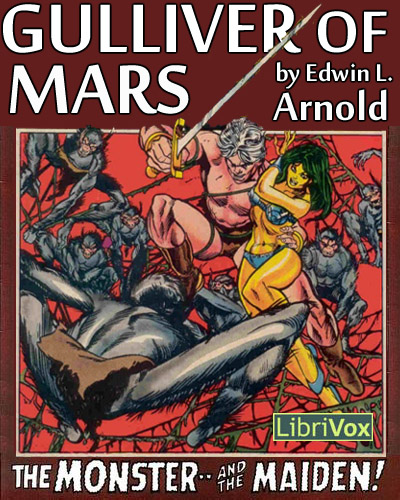
LibriVoxFirst published as Lieutenant Gullivar Jones: His Vacation, in 1905, this novel is a precursor to, and the likely inspiration for, Edgar Rice Burroughs’s classic A Princess of Mars (1911). Despite my not having heard of it before now the novel has a long history of adaptation. Ace Books reprinted Arnold’s novel in paperback in 1964, retitling it Gulliver of Mars [sic]. A more recent Bison Books paperbook edition (from 2003) called it Gullivar of Mars.

Arnold’s novel bears a number of striking similarities to Burroughs’s. Both Gullivar and Burroughs’s protagonists are American servicemen who arrive on an inhabited planet Mars by apparently magical means.

A 2007 paperbook sequel exists: In Edgar Allan Poe on Mars: The Further adventures of Gullivar Jones Gullivar Jones appears alongside a young Edgar Allan Poe (in a series of two linked stories).

Marvel Comics adapted the character for the comic book feature “Gullivar Jones, Warrior of Mars” in issues #16-21 of Creatures on the Loose (March 1972 – Jan. 1973). The story was written by Conan comics scribe Roy Thomas, Gerry Conway, and SF novelist George Alec Effinger. The series then moved to Marvel’s black and white magazine, Monsters Unleashed #4 and #8 (1974). Marvel’s version modernized the setting, recast Gullivar as a Vietnam War veteran (think Heinlein’s Glory Road).

Did I mention I just picked up the first volume of Alan Moore’s League Of Extraordinary Gentlemen? Apparently the next volume includes cameos by both Gullivar and John Carter!

I love LibriVox!

LibriVox Fantasy - Gulliver Of Mars by Edwin L. ArnoldGulliver Of Mars
By Edwin L. Arnold; Read by James Christopher
20 Zipped MP3 Files or Podcast – Approx. 6 Hours 16 Minutes [UNABRIDGED]
Publisher: LibriVox.org
Published: May 3rd 2009
This escapist novel first published in 1905 as Lieutenant Gullivar Jones: His Vacation follows the exploits of American Navy Lieutenant Gulliver Jones, a bold, if slightly hapless, hero who is magically transported to Mars; where he almost outwits his enemies, almost gets the girl, and almost saves the day. Somewhat of a literary and chronological bridge between H.G. Wells and Edgar Rice Burroughs, Jones’ adventures provide an evocative mix of satire and sword-and-planet adventure.

Podcast feed:

http://librivox.org/bookfeeds/gulliver-of-mars-by-edwin-l-arnold.xml

iTunes 1-Click |SUBSCRIBE|

Posted by Jesse Willis

The SFFaudio Podcast #028

Podcast

The SFFaudio PodcastThe SFFaudio Podcast #028 – Jesse and Scott are joined by Luke Burrage of The Science Fiction Book Review Podcast. First up we talk about Luke’s show and reviewing Science Fiction. Later we ask the question for our time: Are the British taking over Science Fiction?

Talked about on today’s show:
Luke Burrage: International Juggler and Entertainer, Juggling Podcasts, Kick-Ass Mystic Ninjas, Gateway by Frederik Pohl, Perdido Street Station by China Miéville, NaNoWriMo, the “Void Trilogy” by Peter F. Hamilton, Richard K. Morgan, Black Man (aka Thirteen) |READ OUR REVIEW|, Altered Carbon |READ OUR REVIEW|, StarShipSofa’s Richard K. Morgan interview, Hominids by Robert J. Sawyer, Dune by Frank Herbert |READ OUR REVIEW|, Nightfall by Isaac Asimov, Nightfall by Isaac Asimov and Robert Silverberg, Use Of Weapons by Iain M. Banks, The Day Of The Triffids by John Wyndham, Alien 3, Blade, The Time Machine by H.G. Wells |READ OUR REVIEW|, I Am Legend by Richard Matheson |READ OUR REVIEW|, Inferno by Larry Niven and Jerry Pournelle |READ OUR REVIEW|, rating systems vs. rankings, The Door Into Summer by Robert A. Heinlein, the PC Gamer Podcast, Singularity Sky by Charles Stross, ebooks, Kirinyaga by Mike Resnick |READ OUR REVIEW|, Market Forces by Richard K. Morgan |READ OUR REVIEW|, Time Station Berlin by David Evans.

Posted by Jesse Willis

Recent Arrivals from Blackstone Audio

SFFaudio Recent Arrivals

The Green Hills of Earth by Robert A. HeinleinThe Green Hills of Earth
By Robert A. Heinlein; Read by Tom Weiner
6 CDs – 6.5 hours – [UNABRIDGED]
Publisher: Blackstone Audio
Published: 2009
ISBN: 9780786167838

We pray for one last landing
On the globe that gave us birth;
Let us rest our eyes on the fleecy skies
And the cool, green hills of Earth.

The Green Hills of Earth is a collection of short stories from one of the masters of science fiction who has held readers spellbound for over thirty years. This collection includes “Delilah and the Space-Rigger,” “Space-Jockey,” “The Long Watch,” “Gentlemen Be Seated,” “The Black Pits of Luna,” “It’s Great to Be Back,” “‘—We Also Walk Dogs,’” “Ordeal in Space,” “The Green Hills of Earth,” and “Logic of Empire.”

 
 
Brotherhood of the Wolf by David FarlandBrotherhood of the Wolf
By David Farland; Read by Ray Porter
18 CDs – 22.5 hours – [UNABRIDGED]
Publisher: Blackstone Audio
Published: 2009
ISBN: 9781433227028

Book Two in the Runelords Series

David Farland delivers the second in his high fantasy Runelords series, featuring a complex system of magic and a wondrous, expertly realized world. Raj Ahten, ruler of Indhopal, has used enough forcibles to transform himself into the ultimate warrior: The Sum of All Men. Ahten seeks to bring all of humanity under his rule, destroying anyone in his path. But young Prince Gaborn has fulfilled a two-thousand-year-old prophecy and become the Earth King, a mythic figure who can unleash the forces of the Earth itself. He has managed to drive off Raj Ahten, but Ahten is far from defeated. Striking at far-flung cities and fortresses, Ahten seeks to draw out the Earth King from his seat of power and to crush him. But as they weaken each other’s forces in battle, the armies of an ancient and implacable inhuman enemy issue forth from the very bowels of the Earth.

 
 
Bellwether by Connie WillisBellwether
By Connie Willis; Read by Kate Reading
5 CDs – 6.5 hours – [UNABRIDGED]
Publisher: Blackstone Audio
Published: 2009
ISBN: 978143324624

Pop culture, chaos theory, and matters of the heart collide in this unique novella from the Hugo and Nebula Award-winning author of Doomsday Book.

Sandra Foster studies fads and their meanings for the HiTek corporation. Bennett O’Reilly works with monkey-group behavior and chaos theory for the same company. When the two are thrust together due to a misdelivered package and a run of seemingly bad luck, they find a joint project in a flock of sheep. But a series of setbacks and disappointments arise before they are able to find answers to their questions—with the unintended help of the errant, forgetful, and careless office assistant Flip.
 
Posted by Scott D. Danielson

Rocket Science 1960 – 1962

SFFaudio News

The Fix - Short Fiction ReviewPosted on March 1 at The Fix: Short Fiction Review is the latest Rocket Science column, which covers 1960 – 1961.

Audio versions of Hugo winners from those years:


1960:
Short Fiction: “Flowers for Algernon” by Daniel Keyes
I couldn’t find an audio version of the novelette version, but the novel version (which later won a Nebula Award) is available from Recorded Books.

Novel: Starship Troopers by Robert A. Heinlein
There are two versions of this – one from Blackstone Audio and one from Recorded Books. See Jesse’s review of both of them for the full scoop.
 
 
1961:
Short Fiction: “The Longest Voyage” by Poul Anderson
This one was included in a Dercum Press collection called No Truce with Kings. |SFFaudio Review|.

Novel: A Canticle for Leibowitz by Walter M. Miller, Jr.
Amazon lists an out-of-print version from Books on Tape, and Wisconsin Public Radio produced a 13 part audio drama for NPR, which you may be able to find.
 
 
1962:
Short Fiction: The “Hothouse” series by Brian W. Aldiss
I couldn’t find this one on audio.

Novel: Stranger in a Strange Land by Robert A. Heinlein
Blackstone Audio has an unabridged production, read by Christopher Hurt.

Posted by Scott D. Danielson

The SFFaudio Podcast #027

Podcast

The SFFaudio PodcastThe SFFaudio Podcast #027 – Jesse and Scott are joined by Rick Jackson (The Time Traveler). Today we talk about new audiobooks, the ongoing CONAN situation, and libraries. Should libraries be renting Zunes to patrons?

Talked about on today’s show:
Ted Chiang, Eclipse 2, Blackstone Audio, The Green Hills Of Earth by Robert A. Heinlein, Apollo 8, Brotherhood Of The Wolf by David Farland, Bellewether by Connie Willis, Corsair by Clive Cussler, James Bond is fantasy?, Quantum Of Solace, Sahara, coming from Wonder AudioThe Fabulous Clipjoint by Frederic Brown, Tantor Media doing Robert E. Howard audiobooks, Conan Properties International versus Broken Sea Audio, New Zealand’s new copyright legislation, reductio ad absurdum, copyrights and trademarks, Clark Ashton Smith, downloading audiobooks through libraries, WMA format, Overdrive vs. NetLibrary, PC Gamer Podcast – ‘X-Box 360, Wii and Playstation 3 are giant DRM keys’, libraries rent DVDs?, ‘government shouldn’t be doing what business can do’.

Posted by Jesse Willis

Review of The Cat Who Walks Through Walls by Robert A. Heinlein

SFFaudio Review

Science Fiction audiobook - The Cat Who Walks Through Walls by Robert A. HeinleinThe Cat Who Walks Through Walls
By Robert A. Heinlein; Read by Tom Weiner
11 CDs – 13.5 Hours [UNABRIDGED]
Publisher: Blackstone Audiobooks
Published: December 2007
ISBN: 1433212918
Themes: / Science Fiction / Marriage / Time Travel / Parallel Worlds / The Moon / Space Station /

When a stranger attempting to deliver a cryptic message is shot dead at his dinner table, Ames is thrown headfirst into danger, intrigue, and other dimensions where Lazarus Long still thrives, where Jubal Harshaw lives surrounded by beautiful women, and where a daring plot to rescue the sentient computer called Mike can change the direction of all human history.

There are a lot of things to dislike about The Cat Who Walks Through Walls:

1. Characters: Heinlein’s characters are either ultra-confident know-it-alls or utterly buffoonish straw-men. Heinlein will happily spend a good ten minutes explaining to you the workings of suborbital flight in a vacuum, but won’t explain (and worse yet – will have the other characters agree) to highly improbable societal systems in cast off sentences like – ‘all sexual options are invested in women’ (on the moon). Then he follows it up with jury trials of accused rapists lasting 30 seconds. Personally, I suspect that any system that threw away habeas corpus in favour of whatever one gender said was good – wouldn’t last very long. It’s possible to imagine a society in which women play a dominant role – but I don’t find it plausible to find any society in which one gender can say one word “rape” (true or not) – and have the accused rapist be instantly ripped apart. Heinlein ignores the problems of: No evidence, no witnesses, no trial. It doesn’t fly Mr. Heinlein.

2. Things missing: First, the internet, especially email, everyone is still mailing paper letters from Lagrange space stations to the Moon! Second, DNA testing. Talk of positively identifying someone all runs along the lines of “fingerprints” and “blood types.” Third, GPS. On Heinlein’s moon you can only tell where you are by using inertial trackers or getting a starfix.

3. A glaring omission: There’s one more thing missing, the last half of the book. Seriously, this book is all prologue, with lots of interesting action, but the entire build up is concluded on the last disc.

4. Too much: There are also things this book has too much of. First, all the many male characters are always calling themselves, denying that they are, or accusing each other of being “henpecked.” This, no matter what universe or era they come from! I’ve never heard any of my married friends use that term. Second, no matter which continent, planet or timeline, the many husbands in this novel come from, they all playfully joke about “beating” their wives. I just don’t know what to do with that information. Is this common in your marriage?

Now, having stated off this review with the above it may sound as if I dislike the novel. And that’s not strictly true. I don’t, not really. But, on the other hand, this is the third audiobook release of it and some of the novelty is starting to wear off. The Cat Who Walks Through Walls has a crackerjack opening scene, some amazing hard SF early on, and a goodly amount of redeeming entertainment value. This is a novel for the truly die-hard Heinlein fans. It was written with the intent of rewarding them for their many years of dedicated reading. It does that. It contains dozens and dozens of characters, many of whom are cameoing from previous Heinlein novels. Lazarus Long (Methusela’s Children), and Hazel Stone (The Rolling Stones) both play substantial roles in the novel. Other characters making appearances include Jubal Harshaw (Stranger In A Strange Land) and Manuel Garcia O’Kelly Davis aka Manny (The Moon Is A Harsh Mistress). In fact, as a reward to loyal readers, The Cat Who Walks Through Walls pairs rather nicely with Heinlein’s The Number Of The Beast in that both it and The Cat Who Walks Through Walls are fond examinations of both the Science Fiction/Fantasy genre and Heinlein’s own career. The key that ties both together is Heinlein’s idea of “pantheistic solipsism.” The idea behind which is that many universes exist under an explanation of ‘the world is myth.’ “The World as Myth” means that influential authors, like L. Frank Baum, Edgar Rice Burroughs, and Heinlein himself are actually creating real parallel universes simply by writing vividly about them. In other words, the fictional stories we really enjoy, ARE ACTUALLY REAL. It’s a neat idea, but it’s better explored in The Number Of The Beast. The Cat Who Walks Through Walls, other than being a rewarding odyssey for fans, is more about marriage than any particular SF idea. Richard Ames gets married in chapter two, and honeymoons on Luna – all the while being chased by assassins and hounded by officious bureaucrats. And that’s where the schism comes in. Heinlein has a no-nonsense, no compromises attitude towards bureaucracy, every situation is black or white. And that holds true for marriage too. Except when it doesn’t. Robert Heinlein Richard Ames will put his foot down, draw a line in the sand, and say “this far no farther”. He’ll hold fast, when confronted by social or bureaucratic interaction not too his liking. He’ll do the same in marriage… and then redraw the lines of his convictions to preserve the marriage. I find the latter rather realistic, but the former utterly unrealistic.

Narrator Tom Weiner has been given the thankless task of voicing about three dozen characters. Worse, there are few attributions in the text itself. Pages and pages of dialogue go by without any breaks. This being the third audiobook edition of The Cat Who Walks Through Walls I think back to George Wilson’s solid reading for Recorded Books, and Robert Vaughn’s abridged reading for Simon & Schuster. Vaughn’s is still my favourite, despite it being abridged to hell. Vaughn should have become a professional audiobook narrator. Weiner’s version, Blackstone’s release, is a close second.

Posted by Jesse Willis