

skulk (v.) /skəlk/ – Keep out of sight, typically with a sinister, evil or cowardly motive
Example: The thief skulked in the shadows.
Skulking Permit is a cute Robert Sheckley story. Frankly, it is not one of his best. His best stuff will send your brain into a week long head-shaking fugue state that’ll leaving you both laughing and crying at the pathetic beast called man. But, Skulking Permit definitely is cute and it definitely does deliver the anthropological satire that Sheckley is so very fond of.
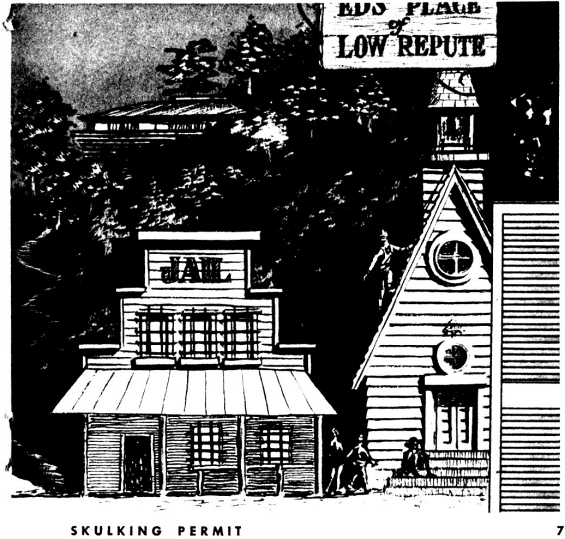
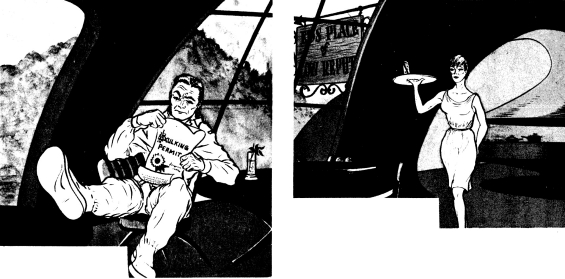
In this case there’s a Earth colony, called New Delaware, which had been cut-off for more than two hundred years. Luckily, it has recently been informed that it’ll be receiving a visit from a representative from Earth. To prepare for the occasion they colonists have decided to make everything familiar to the coming representative – make it all homey, like back on Earth – and so they’ve assigned societal roles to every member of the colony’s community. Everyone is getting used to their characters: the mayor is telling everyone what to do (he’s got to write up some laws real quick) and the police chief has to make his own badge. The little red school house and the little white church are being built and painted and the “no aliens allowed within city limits” sign is being put up. But the plan to make New Delaware a little mirror of Earth aren’t going perfectly smoothly. For what exactly is a criminal? And who can possibly play such a demanding role?
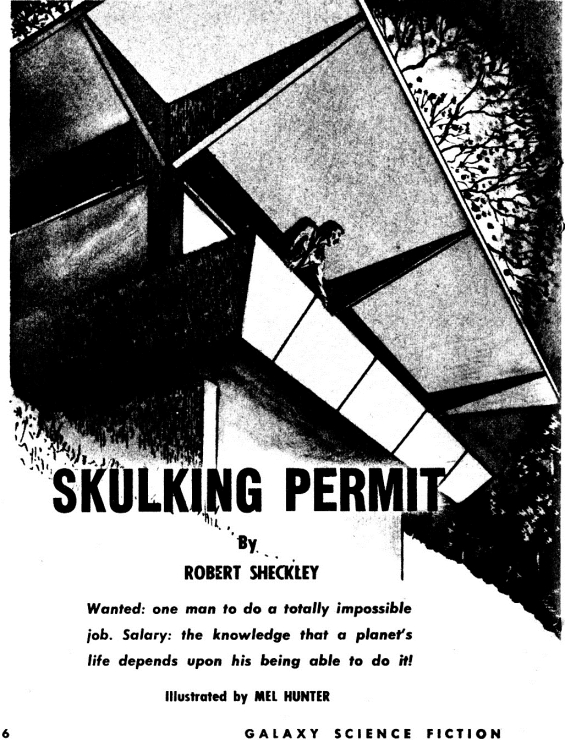
“Wanted: one man to do a totally impossible job. Salary: the knowledge that a planet’s life depends upon his being able to do it!”
 X-Minus One – Skulking Permit
Based on a story by Robert Sheckley; Adapted by Earnest Kinoy; Performed by a full cast
1 |MP3| – Approx. 29 Minutes [RADIO DRAMA]
Broadcaster: NBC Radio
Broadcast: February 15, 1956
Provider: Internet Archive
|SCRIPT|
A small colony, cut off from Earth for generations, must prove they are a model of Earth culture when a ship arrives to effect their ‘reclamation’. They strive to provide archetypes of Earth society, including a town criminal… First published in the December 1954 issue of Galaxy Science Fiction magazine.
Cast:
Dick Hamilton
Wendell Holmes
Joe DeSantis
Joseph Boland
Alan Hewitt
Bill Quinn
Mandel Kramer
Ruby Dee
Announcer …. Jack Costello
Directed by Daniel Sutter
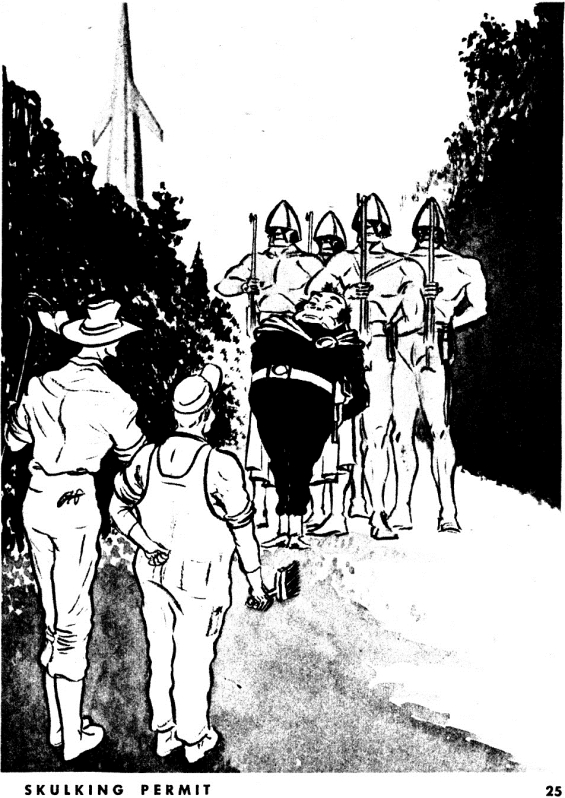
Illustrations, by Mel Hunter, from the original Galaxy publication:
Posted by Jesse Willis





 Robert Sheckley’s Warrior Race was briefly mentioned on last week’s SFFaudio Podcast (
 Warrior Race
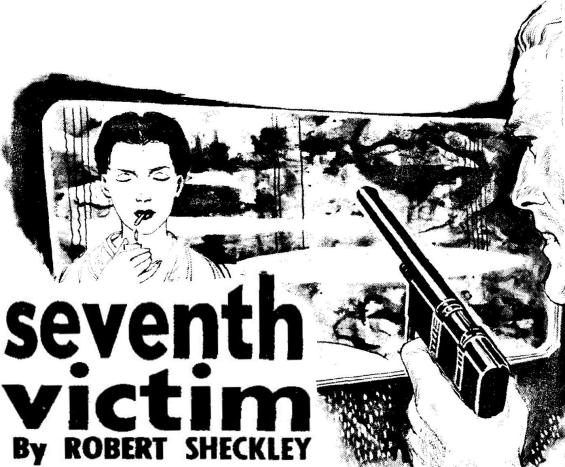 Going in, and liking Robert Sheckley, I was surprised how much I didn’t respond to his most famous short story Seventh Victim. Upon first reading it I didn’t think of it as terrific story. Nor did I think of it as having much in the way of intellectual heft. But, upon reflection, particularly after watching the film adaptation I am coming around a bit. Indeed, plenty of folks, it seems, think of Seventh Victim as an academic story. It’s been used in both introductory psychology and philosophy textbooks. It has been reprinted more than a dozen times in different anthologies or collections. The 1965 film adaptation, called The Tenth Victim (La Decima Vittima), prompted Sheckley to expand the short story into a novel under the same name (which spawned more novel sequels Victim Prime and Hunter / Victim.
 Future Tense – The Seventh Victim