
Commentary: A “Top 100 Sci-Fi Audiobooks” List

SFFaudio Commentary

Sci-Fi ListsLast year somebody* pointed out that a list of “The Top 100 Sci-Fi Books” (as organized by the Sci-Fi Lists website) was almost entirely available in audiobook form!

At the time of his or her compiling 95 of the 100 books were available as audiobooks.

Today, it appears, that list is approaching 99% complete!

I’ve read a good number of the books and audiobooks listed, and while some of them are indeed excellent, I’d have to argue that some are merely ok, and that others are utterly atrocious.

That said, I do think it is interesting that almost all of them are available as audiobooks!

Here’s the list as it stood last year, plus my added notations on the status of the missing five:

01- Ender’s Game – Orson Scott Card – 1985
02- Dune – Frank Herbert – 1965
03- Foundation – Isaac Asimov – 1951
04- Hitchhiker’s Guide To The Galaxy – Douglas Adams – 1979
05- 1984 – George Orwell – 1949
06- Stranger In A Strange Land – Robert A Heinlein – 1961
07- Fahrenheit 451 – Ray Bradbury – 1954
08- 2001: A Space Odyssey – Arthur C Clarke – 1968
09- Starship Troopers – Robert A Heinlein – 1959
10- I, Robot – Isaac Asimov – 1950
11- Neuromancer – William Gibson – 1984
12- Do Androids Dream of Electric Sheep? – Philip K. Dick – 1968
13- Ringworld – Larry Niven – 1970
14- Rendezvous With Rama – Arthur C. Clarke – 1973
15- Hyperion – Dan Simmons – 1989
16- Brave New World – Aldous Huxley – 1932
17- The Time Machine – H.G. Wells – 1895
18- Childhood’s End – Arthur C. Clarke – 1954
19- The Moon Is A Harsh Mistress – Robert A. Heinlein – 1966
20- The War Of The Worlds – H.G. Wells – 1898
21- The Forever War – Joe Haldeman – 1974
22- The Martian Chronicles – Ray Bradbury – 1950
23- Slaughterhouse Five – Kurt Vonnegut – 1969
24- Snow Crash – Neal Stephenson – 1992
25- The Mote In God’s Eye – Larry Niven and Jerry Pournelle – 1975
26- The Left Hand Of Darkness – Ursula K. Le Guin – 1969
27- Speaker For The Dead – Orson Scott Card – 1986
28- Jurassic Park – Michael Crichton – 1990
29- The Man in the High Castle – Philip K. Dick – 1962
30- The Caves Of Steel – Isaac Asimov – 1954
31- The Stars My Destination – Alfred Bester – 1956
32- Gateway – Frederik Pohl – 1977
33- Lord Of Light – Roger Zelazny – 1967
34- Solaris – Stanisław Lem – 1961
35- 20,000 Leagues Under The Sea – Jules Verne – 1870
36- A Wrinkle In Time – Madeleine L’Engle – 1962
37- Cat’s Cradle – Kurt Vonnegut – 1963
38- Contact – Carl Sagan – 1985
39- The Andromeda Strain – Michael Crichton – 1969
40- The Gods Themselves – Isaac Asimov – 1972
41- A Fire Upon The Deep – Vernor Vinge – 1991
42- Cryptonomicon – Neal Stephenson – 1999
43- The Day of the Triffids – John Wyndham – 1951
44- UBIK – Philip K. Dick – 1969
45- Time Enough For Love – Robert A. Heinlein – 1973
46- A Clockwork Orange – Anthony Burgess – 1962
47- Red Mars – Kim Stanley Robinson – 1992
48- Flowers For Algernon – Daniel Keyes
49- A Canticle For Leibowitz – Walter M. Miller – 1959
50- The End of Eternity – Isaac Asimov – 1955
51- Battlefield Earth – L. Ron Hubbard – 1982
52- Frankenstein – Mary Shelley – 1818
53- Journey To The Center Of The Earth – Jules Verne – 1864
54- The Dispossessed – Ursula K. Le Guin – 1974
55- The Diamond Age – Neal Stephenson – 1995
56- The Player Of Games – Iain M. Banks – 1988
57- The Reality Dysfunction – Peter F. Hamilton – 1996
58- Startide Rising – David Brin – 1983
59- The Sirens Of Titan – Kurt Vonnegut – 1959
60- Eon – Greg Bear – 1985
61- Ender’s Shadow – Orson Scott Card – 1999
62- To Your Scattered Bodies Go – Philip Jose Farmer – 1971
63- A Scanner Darkly – Philip K. Dick – 1977
64- Lucifer’s Hammer – Larry Niven and Jerry Pournelle – 1977
65- The Handmaid’s Tale – Margaret Atwood – 1985
66- The City And The Stars – Arthur C Clark – 1956
67- The Stainless Steel Rat – Harry Harrison – 1961
68- The Demolished Man – Alfred Bester – 1953
69- The Shadow of the Torturer – Gene Wolfe – 1980
70- Sphere – Michael Crichton – 1987
71- The Door Into Summer – Robert .A Heinlein – 1957
72- The Three Stigmata Of Palmer Eldritch – Philip K. Dick – 1964
73- Revelation Space – Alastair Reynolds – 2000
74- Citizen Of The Galaxy – Robert A. Heinlein – 1957
75- Doomsday Book – Connie Willis – 1992
76- Ilium – Dan Simmons – 2003
77- The Invisible Man – H.G. Wells – 1897
78- Have Space-Suit Will Travel – Robert A. Heinlein – 1958
79- The Puppet Masters – Robert A. Heinlein – 1951
80- Out Of The Silent Planet – C.S. Lewis – 1938
81- A Princess of Mars – Edgar Rice Burroughs – 1912
82- The Lathe of Heaven – Ursula K. Le Guin – 1971
83- Use Of Weapons – Iain M. Banks – 1990
84- The Chrysalids – John Wyndham – 1955
85- Way Station – Clifford Simak – 1963
86- Flatland – Edwin A. Abbott – 1884
87- Altered Carbon – Richard Morgan – 2002
88- Old Man’s War – John Scalzi – 2005
89- COMING SOON (October 15, 2012)Roadside Picnic – Arkady and Boris Strugatsky – 1972
90- The Road – Cormac McCarthy – 2006
91- The Postman – David Brin – 1985
92- NEWLY AVAILABLEStand On Zanzibar – John Brunner – 1969
93- VALIS – Philip K. Dick – 1981
94- NEWLY AVAILABLE The Cyberiad: Fables for the Cybernetic Age – Stanisław Lem – 1974
95- NOT AVAILABLE AS AN AUDIOBOOK – Cities In Flight – James Blish – 1955
96- The Lost World – Sir Arthur Conan Doyle – 1912
97- The Many-Colored Land – Julian May – 1981
98- Gray Lensman – E.E. ‘Doc’ Smith – 1940
99- The Uplift War – David Brin – 1987
100- NEWLY AVAILABLEThe Forge Of God – Greg Bear – 1987

In case you were wondering, the list was compiled using the following criteria:

“A statistical survey of sci-fi literary awards, noted critics and popular polls. To qualify a book has to be generally regarded as science fiction by credible sources and/or recognised as having historical significance to the development of the genre. For books that are part of a series (with some notable exceptions) only the first book in the series is listed.”

The “Next 100”, as listed over on Sci-Fi Lists, has a lot of excellent novels and collections in it too, check that out HERE.

[*Thanks to “neil1966hardy” from ThePirateBay]

Posted by Jesse Willis

Fantasy and Science Fiction: The Human Mind, Our Modern World with Eric Rabkin

SFFaudio News

Our good friend, Professor Eric S. Rabkin, is teaching one of the free summer Coursera courses. It’s entitled Fantasy and Science Fiction: The Human Mind, Our Modern World and all of the required readings, except for two of the novels, are available free online!

Here’s the official description:

Fantasy is a key term both in psychology and in the art and artifice of humanity. The things we make, including our stories, reflect, serve, and often shape our needs and desires. We see this everywhere from fairy tale to kiddie lit to myth; from “Cinderella” to Alice in Wonderland to Superman; from building a fort as a child to building ideal, planned cities as whole societies. Fantasy in ways both entertaining and practical serves our persistent needs and desires and illuminates the human mind. Fantasy expresses itself in many ways, from the comfort we feel in the godlike powers of a fairy godmother to the seductive unease we feel confronting Dracula. From a practical viewpoint, of all the fictional forms that fantasy takes, science fiction, from Frankenstein to Avatar, is the most important in our modern world because it is the only kind that explicitly recognizes the profound ways in which science and technology, those key products of the human mind, shape not only our world but our very hopes and fears. This course will explore Fantasy in general and Science Fiction in specific both as art and as insights into ourselves and our world.

This course comprises ten units. Each will include a significant reading, typically a novel or a selection of shorter works. I will offer video discussions of each of the readings and also of more general topics in art and psychology that those readings help illuminate. Each unit will include online quizzes and ask you to write a brief essay offering your own insights into the reading. In order, the units are:

Grimm — Children’s and Household Tales
Carroll — Alice’s Adventures in Wonderland and Through the Looking-Glass
Stoker — Dracula
Shelley — Frankenstein
Hawthorne & Poe — Stories and Poems
Wells — The Island of Dr. Moreau, The Invisible Man, “The Country of the Blind,” “The Star
Burroughs & Gilman — A Princess of Mars & Herland
Bradbury — The Martian Chronicles
LeGuin — The Left Hand of Darkness
Doctorow — Little Brother

In Unit I, the specific stories are the ones in the Lucy Crane translation (1886) which was published by Dover and is available online through Project Gutenberg (http://www.gutenberg.org/ebooks/5314). In Unit V, the specific readings are: Hawthorne’s “The Birthmark,” “Rappaccini’s Daughter,” “Dr. Heidegger’s Experiment,” and “The Artist of the Beautiful“; Poe’s “The Fall of the House of Usher,” “The Tell-Tale Heart,” “The Black Cat,” “The Facts in the Case of M. Valdemar,” “The Bells,” “The Raven,” “Annabel Lee.” All the readings except Ray Bradbury’s The Martian Chronicles and Ursula K. LeGuin’s The Left Hand of Darkness will be available online at no charge.

[thanks Jenny!]

Posted by Jesse Willis

National Endowment for the Arts: Big Read: A Wizard Of Earthsea by Ursula K. Le Guin

SFFaudio Online Audio

National Endowment for the Arts: Big ReadThe National Endowment for the Arts presents a complied interview piece on Ursula K. Le Guin’s A Wizard Of Earthsea.

Contributors include Michael Chabon, Kelly Link, Orson Scott Card, Walter Mosley, R.L. Stine and Le Guin herself!

|MP3|

Subscribe via the podcast feed:

http://feeds2.feedburner.com/neabigread

Posted by Jesse Willis

1979 Philip K. Dick interview with Charles Platt (Santa Ana, California)

SFFaudio Online Audio

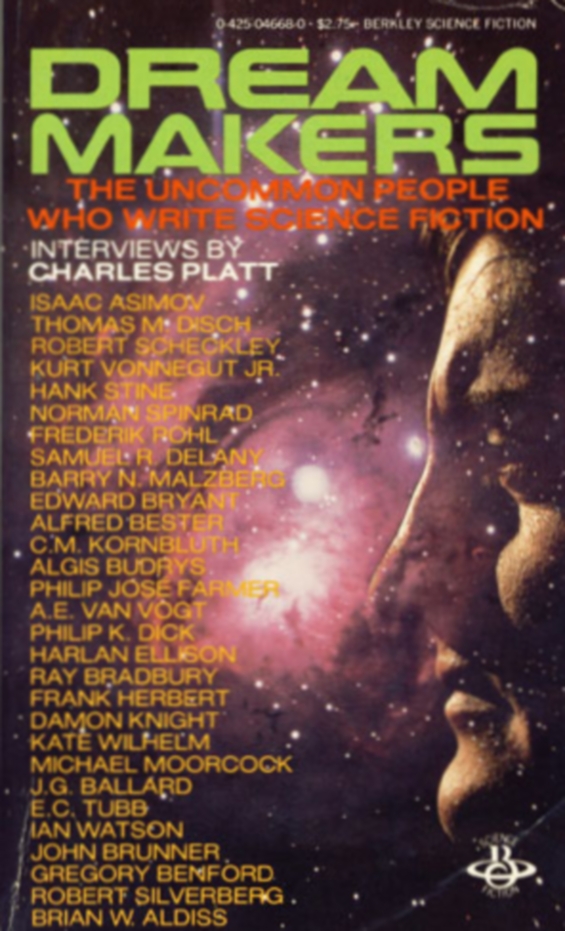
This essential interview with Philip K. Dick, conducted by Charles Platt and recorded in 1979 in Santa Ana, California, is sure to be immensely important for Dick scholars. It was recorded for Platt’s book Dream Makers: The Uncommon People Who Write Science Fiction.

Here’s the video converted back to audio, |MP3| and although it isn’t huffduffable, it is downloadable.

Notes:
-Dick was “plenty peculiar” because he read books
-he wasn’t gay despite his hanging around with gay friends
-Quakers were about the only group in the world Dick didn’t have some sort of grievance against
-Dick claims to have been kicked out of university for failing mandatory ROTC training
-Dick read The World Of Null-A by A.E. van Vogt and found in it great inspiration for his ideas about the perception of reality and reality itself
-Dick perceived his high school geometry teacher as a mechanism
Roog and other “interior projection stories”
-Dick’s fiction can be incomprehensible if you do not accept his premise (namely that “each of us lives in a unique world.”)
Martian Time Slip.
-When Dick went to a psychotherapist he was told he was an alcoholic (despite his being a teetotaler)
-“attack therapy”
-totalitarian communities
-why Dick writes about anti-heroes
-paranoia
-“I am inevitably persuaded by every argument that is brought to bare”
-private worlds
The Three Stigmata Of Palmer Eldritch
Time Out Of Joint
-artificial memories / false memories
-the influence of drugs on Dick’s writing was only in the output (using amphetamines he was completing 60 finished pages per day)
-Dick’s one real acid trip
A Scanner Darkly
-cats and cat curiosity
-Carl Jung and “the collective unconscious”
-John Belushi (on Saturday Night Live)
-WWI and the battle of The Marne
-Sergei Eisenstein’s Alexander Nevsky
-WWI and the battle of The Marne
-Dick’s father fought in WWI (in the 5th Marines) and told Philip the stories about it
All Quiet On The Western Front by Erich Maria Remarque
-“the god of this world is evil”
Maze Of Death
Ubik
Eye In The Sky
-WWII
-something is terrible is wrong (when everyone cheers a burning man)
-empathy for animals (human and rodent)
-the killing of a rat (haunted Dick)
-Buddha
Flow My Tears, the Policeman Said
-lambs and sheep
Valis (his then latest novel)
-standing on the shoulders of giants
-disorder (evil) -> order (benign)
-Dick claims to have been eccentric but not insane
-“it fired my agent, it fired my publisher” (it being the spirit that was possessing him)
-Dick’s letter to the Roman Catholic Church (about the miracle that occurred)
-conspiracies
-the Cumaean Sibyl informed Dick that the American Republic is in danger of turning into the American Empire (in 1974)
-PKD on censorship (he’s against it, unless you aren’t)
-the War Of The Spanish Lowlands
-Congressman Charles E. Wiggins got letters from Dick (written while he was possessed by the spirit of the Cumaean Sibyl)
-the Nixon tape transcripts were forgeries (according to Dick’s Cumaean Sibyl)
-the Paul Williams article in Rolling Stone on Dick
-Dick’s tutelary spirit promised to return Dick to a garden upon his deathbed
Diana
-Norman Spinrad
-“I’m in the Portuguese States Of America”
-a Chinese finger trap
We Can Build You
-Platt: “Do you recognize the possibility that you were talking to yourself?” Dick: “Yes.”
-multiple personalities
-Archimedes principle
Faith Of Our Fathers
-Ursula K. Le Guin thought Dick was crazy
-pre-socratic philosophy

Dream Makers: The Uncommon People Who Write Science Fiction

[via SFSignal.com and youtubemp3.tv]

Posted by Jesse Willis

Podcasts: Week Ending Oct 22, 2011

SFFaudio Online Audio

Mentat Jack I’m writing about what I listen to, what it makes me think about and what you might find interesting. Let me know if you think there’s something important I’m missing and if there’s a SFF related podcast you listened to during the week (no matter when it was published) that I should spotlight here.


This week’s post is quite late, but I’m continuing to enjoy reflecting back on what I listen to.

Writing Excuses 6.20: Endings brought to mind the discussion on a recent (for me, it may actually have been the first episode) SF Squeecast, in which an affectionate bashing of Christopher Priest “everyone just walks off stage” endings ensued. Lou Anders joined writing excuses again and endings were discussed largely in relation to the Hollywood formula. Lots of info in 15 minutes and they lie. They’re all super smart. |MP3|

Adventures In SciFi Publishing continues to publish twice a week. Episode 143 discussed Amazon’s new imprint, 47North. Amazon is in a spectacular position for trend spotting and they’re flush with cash to pay for the editing/marketing/etc. needed to make a successful publishing venue. AiSFP ask a good question, will B&N carry these books? They also talk with Brenda Cooper. It’s interesting to hear a futurist talk about her fantasy time travel novel. I’ve not yet read any Cooper, but she’s always a delightful guest. |MP3|

Gary K. Wolfe, Ursula K. Le Guin and Jonathan Strahan (Coode Street Podcast 71) politely roast Margaret Attwood’s book, In Other Worlds: SF and the Human Imagination. This mainstream/literary vs genre discussion rears it’s head constantly (see SF signal’s latest mind meld) and in many fan’s minds Attwood is the poster child for the “I do not write science fiction” crowd. It was pleasant to hear 3 intelligent people at the core of science fiction look at Attwoods relationship with science fiction from every possible angle. |MP3|

Pony by Erik Amundsen is a pure Clarkesworld story (podcast). It’s dark, stylized and highly original science fiction. Told from the first person, this tale of wrangling genetically engineered war ships mixes SF and western so seamlessly that Firefly seems positively mainstream in comparison. |MP3|

Pseudopod is my main audio stop for straight out horror. I’d love a suggestion for another podcast of similar quality to add into the mix. That’s not to say I didn’t enjoy this week’s tale of a young serial killer and his abusive father. Yardwork was particularly well read. Personally, the level of abuse from the father seemed a bit over the top. I bring that up because of my comment about Radio Nowhere last week. I’m quite happy that the closest experience I have to abuse involved the occasional cruel interaction with childhood “friends.” I digress. The story sort of offers the satisfaction of Dexter, but no matter how sympathetic the protagonist is, there’s no question that he’s a very, very bad boy. |MP3|

While on Pseudopod, I REALLY loved The Cord by Chris Lewis Carter. Usually, when I encounter an idea in a story I’ve recently encountered in a non-fiction science venue, I’m reading science fiction. It’s awesome to encounter this in horror and basically makes strict genre boundaries seem particularly silly. In this case an unreliable narrator is used to great affect in a deceptively simple extrapolation from true stuff that actually happens. Even if horror isn’t normally your cup of tea, don’t miss this one. |MP3|

The second AiSFP I listened to this week involved an interview with K.V. Johansen. I think Lou Anders, her publisher, did a better job making this sound like a must read book in an earlier podcast. That said, she made the world seem like one that will take nicely to a long series and I’m intrigued by some of her earlier fiction for younger readers. Shaun is experimenting a lot with the format of the show, in this case breaking up the interview with a “from the editor’s desk” segment. I’m not sure how I feel about the contrast between a discussion of epic fantasy and a question about the state of science fiction, but the more dynamic format definitely adds life to the show. |MP3|

Episode 315 of Escapepod is Clockwork Fagin by Cory Doctorow. It’s from the new anthology Steampunk! and it’s a both a wonderful example of steampunk and just a great story. It’s full of Dickensian orphans, clockwork analytical engines, and murder – told with a maker ethic that you’d expect from Doctorow. |MP3|

Posted by Steven Klotz

CBC Q: Interview with Margaret Atwood

SFFaudio Online Audio

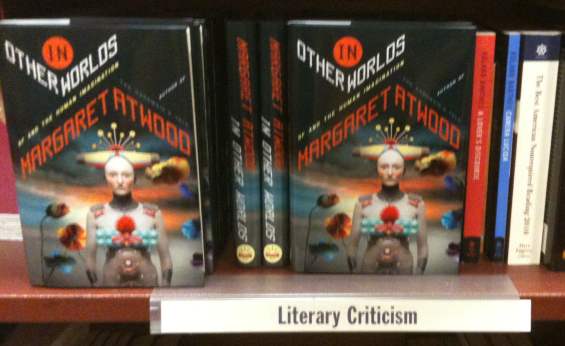
CBC Radio One - Q: The PodcastHost Jian Ghomeshi of CBC Radio One’s Q has an astounding new interview with Margaret Atwood. Atwood’s latest book, In Other Worlds: SF And The Human Imagination, can be found in the “Literary Criticism” section of your local paperbook store.

Gomeshi talked to Atwood about the realistic novel, comics, Weird Tales and the “sluttish” reputation of SF.

In Other Worlds by Margaret Atwood

One point in the interview left me confused and asking questions. Atwood claimed that “Conan the Barbarian is the literary descendant of Walt Whitman … and Henry James”.

I am floored.

What the fuck is she talking about?

Seriously, did she misspeak?

Did she mean to say that Robert E. Howard himself was their literary descendant?

Surely she didn’t mean the the character. Either way I don’t get it.

Or maybe she meant the stories themselves were somehow in the tradition of Walt Whitman and Henry James??? How could that be?

No matter how I look at it I don’t see how either Walt Whitman or Henry James ties into Howard. It just doesn’t make any kind of sense to me.

Does anybody know what the hell Atwood meant by that?

Seriously, I do not get it.

Will I have to buy her book to understand this thesis?

Have a listen |MP3|.

Podcast feed: http://www.cbc.ca/podcasting/includes/qpodcast.xml

Posted by Jesse Willis

P.S. CBC, please release Apocalypse Al. You can call it “scientific romance” or something else, just release it.