News, Reviews, and Commentary on all forms of science fiction, fantasy, and horror audio. Audiobooks, audio drama, podcasts; we discuss all of it here. Mystery, crime, and noir audio are also fair game.
Check out the impressive list of narrators reading the stories in this new FREE short story collection from Cory Doctorow. The Neil Gaiman read story, The Right Book, takes on the future of books, ebooks and publishing. The Wil Wheaton read story, Scroogled, imagines a future (or perhaps present) in which your Google searches shall be held against you in the airport security screening, free wi-fi and webcams everywhere means you’ve constantly surveilled and Cardinal Richelieu get’s his revenge. This is a very cool project.
I’ve added a HuffDuffer podcast feed for the the entire collection or pick and choose individual stories.
With A Little Help
By Cory Doctorow; Read by various 14 Zipped MP3 Files or Podcast – Approx. 10 Hours 25 Minutes [UNABRIDGED]
Publisher: Craphound.com
Published: December 7, 2010 With A Little Help is my first serious experiment in self-publishing. I’ve published many novels, short story collections, books of essays and so on with publishers, and it’s all been very good and satisfying and educational and so on, but it seems like it’s time to try something new. With A Little Help consists of 12 stories, all reprints except for “Epoch” (commissioned by Mark Shuttleworth) This book is also available as a limited edition hardcover, a free ebook (in several formats) and an audiobook. It is licensed Creative Commons BY-NC-SA. Download the book, buy the limited edition hardcover and audiobooks at craphound.com/walh. This cover by Rick Lieder. Three other covers available.
1. Introduction
By Jonathan Coulton; Read by Jonathan Coulton
1 |MP3| – Approx. 6 Minutes [UNABRIDGED]
2. The Things That Make Me Weak and Strange Get Engineered Away
By Cory Doctorow; Read by Hugh A.D. Spencer
1 |MP3| – Approx. 1 Hour 22 Minutes [UNABRIDGED]
3. The Right Book
By Cory Doctorow; Read by Neil Gaiman
1 |MP3| – Approx. 17 Minutes [UNABRIDGED]
4. Other Peoples’ Money
By Cory Doctorow; Read by Mur Lafferty
1 |MP3| – Approx. 15 Minutes [UNABRIDGED]
5. Scroogled
By Cory Doctorow; Read by Wil Wheaton
1 |MP3| – Approx. 40 Minutes [UNABRIDGED]
6. Human Readable
By Cory Doctorow; Read by Spider Robinson
1 |MP3| – Approx. 1 Hour 38 Minutes [UNABRIDGED]
7. Liberation Spectrum
By Cory Doctorow; Read by Leo Laporte
1 |MP3| – Approx. 55 Minutes [UNABRIDGED]
8. Power Punctuation!
By Cory Doctorow; Read by Patrick Nielsen Hayden
1 |MP3| – Approx. 30 Minutes [UNABRIDGED]
9. Visit The Sins
By Cory Doctorow; Read by Roy Trumbull
1 |MP3| – Approx. 49 Minutes [UNABRIDGED]
10. Constitutional Crisis
By Cory Doctorow; Read by J.C. Hutchins
1 |MP3| – Approx. 16 Minutes [UNABRIDGED]
11. Pester Power
By Cory Doctorow; Read by Mary Robinette Kowal
1 |MP3| – Approx. 12 Minutes [UNABRIDGED]
12. Chicken Little
By Cory Doctorow; Read by Emily Hurson
1 |MP3| – Approx. 2 Hours 7 Minutes [UNABRIDGED]
13. Epoch
By Cory Doctorow; Read by Jesse Brown
1 |MP3| – Approx. 1 Hour 24 Minutes [UNABRIDGED]
14. Afterword: I’m Only In It For The Money
By Russell Galen; Read by Russell Galen
1 |MP3| – Approx. 9 Minutes [UNABRIDGED]
Which website has a stack of more than a dozen recently arrived audiobooks looking for reviews? Would you be surprised to learn it’s called SFFaudio.com? We knew you knew that.
Nearly 200 ratings on audible, where it premiered back in July, give this audiobook a score of 4.39 out of 5. Impressive. And, check it out, narrator Jay Snyder (aka Dan Green) is also the voice actor for Yugi Moto from the Yu-Gi-Oh! anime series.
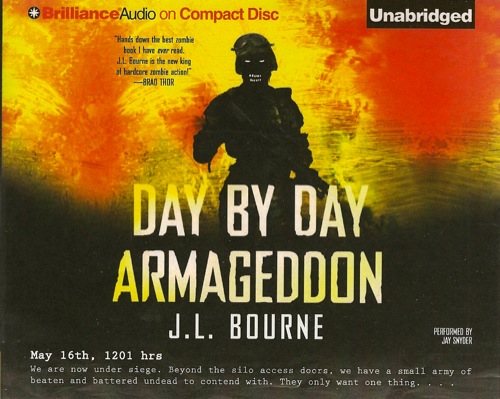
Beyond Exile: Day By Day Armageddon (book 2 in the Armageddon series)
By J.L. Bourne; Read by Jay Snyder
8 CDs – Approx. 10 Hours [UNABRIDGED]
Publisher: Brilliance Audio
Published: August 10, 2010
ISBN: 9781441874863
Sample: |MP3| START INTERCEPT – Armies of undead have risen up across the U.S. and around the globe; there is no safe haven from the diseased corpses hungering to feed off human flesh. But in the heat of a Texas wasteland, a small band of survivors attempt to counter the millions closing in around them. – INTERCEPT COMPLETE — Survivor, Day by day, the handwritten journal entries of one man caught in a worldwide cataclysm capture the desperation — and the will to survive — as he joins forces with a handful of refugees to battle soulless enemies both human and inhuman from inside the abandoned Hotel 23. But in the world of the undead, is mere survival enough?
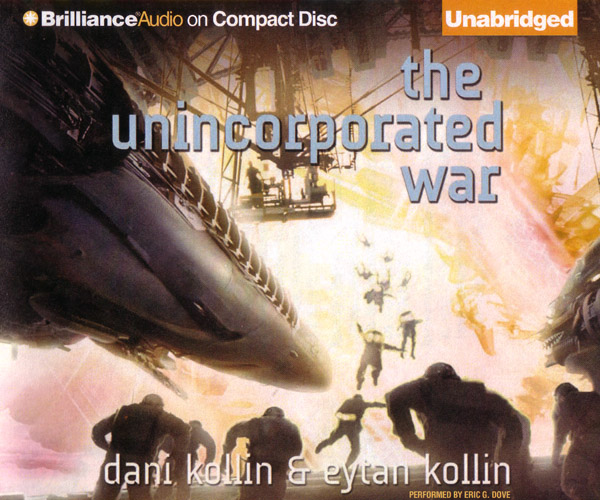
Here’s the follow up to The Unincorporated Man |READ OUR REVIEW|. The part I like most about this sequel is that it is slightly shorter than the original.
The Unincorporated War
By Dani Kollin and Eytan Kollin; Read by Eric G. Dove
19 CDs – Approx. 22 Hours 37 Minutes [UNABRIDGED]
Publisher: Brilliance Audio
Published: May 11, 2010
ISBN: 1441858016
Sample: |MP3| The Kollin brothers introduced their future world, and central character Justin Cord, in The Unincorporated Man. Justin created a revolution in that book, and is now exiled from Earth to the outer planets, where he is a heroic figure. The corporate society, which is headquartered on Earth and rules Venus, Mars, and the Orbital colonies, wants to destroy Justin and reclaim hegemony over the rebellious outer planets. The first interplanetary civil war begins as the military fleet of Earth attacks. Filled with battles, betrayals, and triumphs, The Unincorporated War is a full-scale space opera that catapults the focus of the earlier novel up and out into the solar system. Justin remains both a logical and passionate fighter for the principles that motivate him, and the most dangerous man alive.
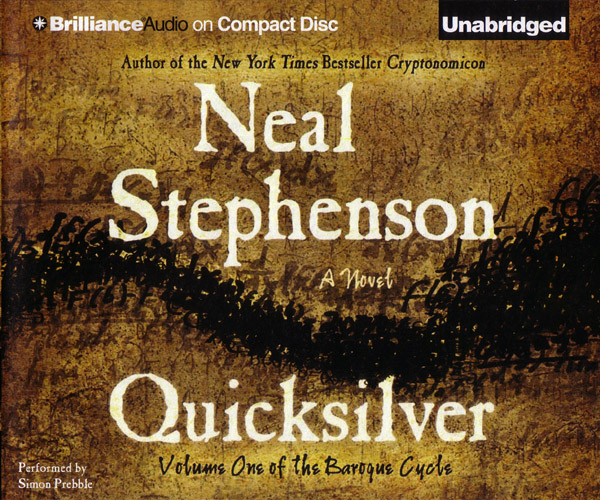
Neal Stephenson’s “Baroque Cycle” – no matter how you measure it – begins with this audibook. I’m always for starting at the beginning.
Quicksilver
By Neal Stephenson; Read by Simon Prebble
12 CDs – Approx. 14 Hours 35 Minutes [UNABRIDGED]
Publisher: Brilliance Audio
Published: August 2010
ISBN: 9781441874962
Sample: |MP3| Quicksilver is the story of Daniel Waterhouse, fearless thinker and conflicted Puritan, pursuing knowledge in the company of the greatest minds of Baroque-era Europe, in a chaotic world where reason wars with the bloody ambitions of the mighty, and where catastrophe, natural or otherwise, can alter the political landscape overnight.
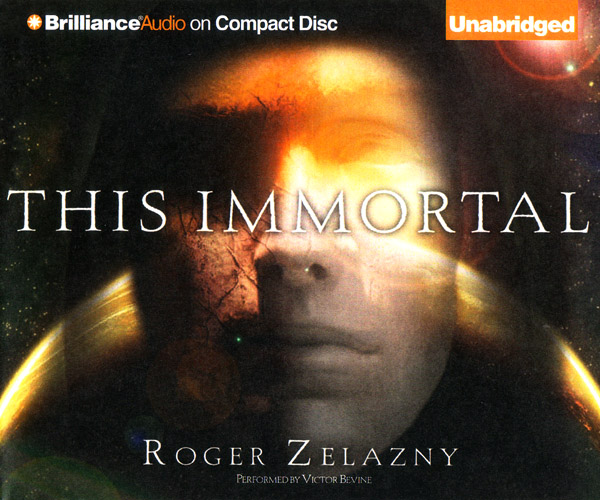
This mortal, meaning me, plans on listening to this intriguing sounding book before the year is out. It was originally published, in a shorter version, under the title … And Call Me Conrad. Check out the fascinating Wikipedia entry describing its long an convoluted publishing history.
This Immortal
By Roger Zelazny; Read by Victor Bevine
6 CDs – Approx. 6 Hours 29 Minutes [UNABRIDGED]
Publisher: Brilliance Audio
Published: August 25, 2010
ISBN: 1441875018 Conrad Nomikos has a long, rich personal history that he’d rather not talk about. And, as arts commissioner, he’s been given a job he’d rather not do. Escorting an alien grandee on a guided tour of the shattered remains of Earth is not something he relishes – especially since it is apparent that this places him at the center of high-level intrigue that has some bearing on the future of Earth itself. But Conrad is a very special guy…
Narrator Christina Traister, in addition to narrating audiobooks, also teaches stage combat in the Department of Theatre at Michigan State University. That’s cool.
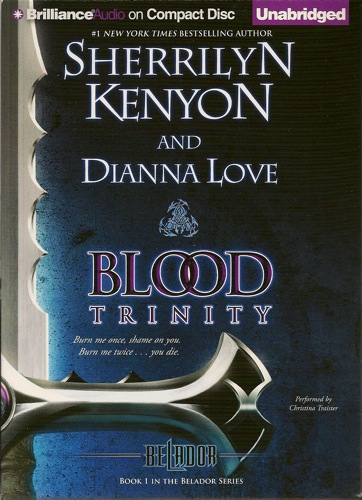
Blood Trinity: The Belador Code, Book 1
By Sherrilyn Kenyon and Dianna Love; Read by Christina Traister
11 CDs – Approx. 13 Hours [UNABRIDGED]
Publisher: Brilliance Audio
Published: October 19, 2010
ISBN: 9781441863515
Sample: |MP3| Atlanta has become the battlefield between human and demon. All her life, Evalle Kincaid has walked the line between the two. Her origins unknown, she’s on a quest to learn more about her past … and her future. When a demon claims a young woman in a terrifying attack and there’s no one else to blame, Evalle comes under suspicion. Now she’s on a deadly quest for her own survival. Through the sordid underground of an alternate Atlanta where nothing is as it seems to the front lines of the city, where her former allies have joined forces to hunt her, Evalle must prove her innocence or pay the ultimate price. But saving herself is the least of her problems if she doesn’t stop the coming apocalypse. The clock is ticking and Atlanta is about to catch fire…
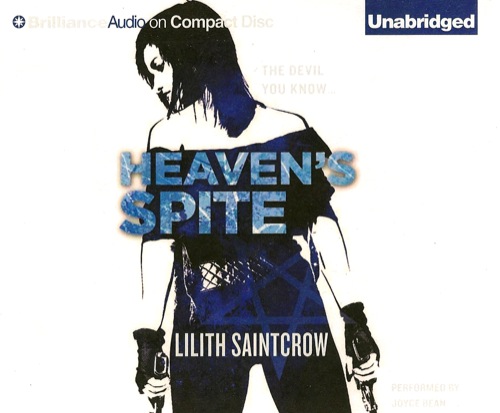
Not only does the protagonist of Heaven’s Spite have unbelievably fake sounding name, so does the author. Lillith Saintcrow, however, insists that it is in fact her real name! Now considering how cool sounding it is I can entirely imagine someone having her name legally changed to Lillith Saintcrow. And, I’ve also got to hand it to any author/character combination who can use the word “Fuckwad” in the opening of her paranormal romance parkour novel! Check out how they made the cover for another of Saintcrow’s urban fantasy books too.
Heaven’s Spite: Book 5 in the Jill Kismet series
By Lilith Saintcrow; Read by Joyce Bean
7 CDs – Approx. 8 Hours [UNABRIDGED]
Publisher: Brilliance Audio
Published: October 27, 2010
ISBN: 9781441886835
Sample: |MP3| Jill Kismet has no choice but to seek treacherous allies — Perry, the devil she knows, and Melisande Belisa, the cunning Sorrows temptress whose true loyalties are unknown. Kismet knows Perry and Belisa are likely playing for the same thing — her soul. It’s just too bad, because she expects to beat them at their own game. Except their game is vengeance. Nobody plays vengeance like Kismet. But if the revenge she seeks damns her, her enemies might get her soul after all…
Cherie (aka BelovedBitterSea) sez: “genocide is bad and life should be fair” – You know I’m liking YouTube more and more if only for reviews like Cherie’s – it’s for Foundation, the novel preceding this audiobook…
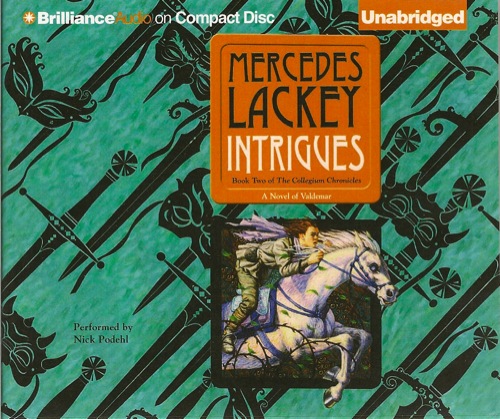
Intrigues: Valdemar: Collegium Chronicles, Book 2
By Mercedes Lackey; Read by Nick Podehl
9 CDs – Approx. 10 Hours [UNABRIDGED]
Publisher: Brilliance Audio
Published: October 5, 2010
ISBN: 9781423308003
Sample: |MP3| Mags was an orphan and slave of ‘bad blood’ who toiled a gem mine all his young life. He would have died before adulthood, had he not been Chosen and taken to Haven to be trained in the new Herald Collegium. Now, Mags was never hungry and never cold. He slept in a real bed in his own room and, most importantly, he had Dallen, who was like another part of himself. And yet, aside from Lena and Bear, both loners like he was, he couldn’t relate to most of the Herald, Healer, or Bard trainees. He was the only trainee who came from what—to the others—was unimaginable poverty. There was another factor that contributed to Mag’s isolation. Foreign assassins, masquerading at court as envoys were discovered. As they fled from the Guard, one of them seemed to “recognize” Mags. Now, Mags was an object of suspicion. He had always been curious about his parents, but after the incident it became urgent for Mags to discover exactly who his parents were. And at Haven, he had access to the extensive Archives. Poring through the Archives, he got only incomplete information: his parents, found dead in a bandit camp, had been two of a number of hostages, some of whom had survived. The survivors had told the Guard that Mags’ parents spoke a language that no one understood or recognized. This information did not help, for the ForeSeers had been having visions of the king’s assassination by “one of the foreign blood”. Some had even Seen Mags with blood on his hands. How could Mags defend himself against a crime that hadn’t yet been committed?
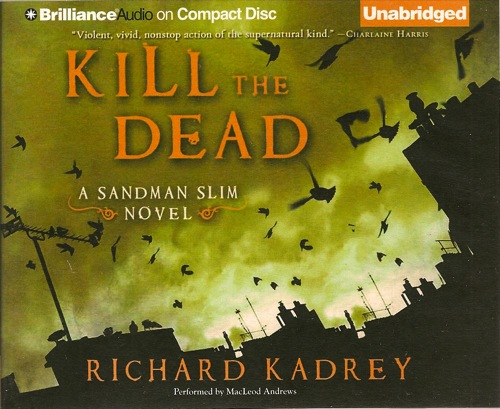
Here’s the sequel to Sandman Slim. It’s a paranormal romance/urban fantasy told humorously in first person! Narrator MacLeod Andrews sounds very good while telling the story with what sounds like a conspiratorial smirk. Check out Kadrey’s video about the first book in the series too.
Kill The Dead
By Richard Kadrey; Read by MacLeod Andrews
11 CDs – Approx. 13 Hours [UNABRIDGED]
Publisher: Brilliance Audio
Published: October 5, 2010
ISBN: 9781441806642
Sample: |MP3| James Stark, a.k.a. Sandman Slim, crawled out of Hell, took bloody revenge for his girlfriend’s murder, and saved the world along the way. After that, what do you do for an encore? You take a lousy job tracking down monsters for money. It’s a depressing gig, but it pays for your beer and cigarettes. But in L.A., things can always get worse. Like when Lucifer comes to town to supervise his movie biography and drafts Stark as his bodyguard. Sandman Slim has to swim with the human and inhuman sharks of L.A.’s underground power elite. That’s before the murders start. And before he runs into the Czech porn star who isn’t quite what she seems. Even before all those murdered people start coming back from the dead and join a zombie army that will change our world and Stark’s forever. Death bites. Life is worse. All things considered, Hell’s not looking so bad.
Narrator Ralph Lister reads with an English accent. If I had my drothers all aliens (and Nazis) would be played by English actors. First published in 1968.
Priest-Kings Of Gor: Gorean Saga, Book 3
By John Norman; Read by Ralph Lister
11 CDs – Approx. 13 Hours [UNABRIDGED]
Publisher: Brilliance Audio
Published: October 15, 2010
ISBN: 9781441849021
Sample: |MP3| This is the third installment of John Norman’s popular and controversial Gor series. Tarl Cabot is the intrepid tarnsman of the planet Gor, a harsh society with a rigid caste system that personifies the most brutal form of Social Darwinism. In this volume, Tarl must search for the truth behind the disappearance of his beautiful wife, Talena. Have the ruthless Priest-Kings destroyed her? Tarl vows to find the answer for himself, journeying to the mountain stronghold of the kings, knowing full well that no one who has dared approach the Priest-Kings has ever returned alive….
Told in first person, by the chameleon voiced Phil Gigante, here’s the 1970 sequel to an audiobook I am listening to right now. I suspect I’ll be gobbling up this sequel soon too.
The Stainless Steel Rat’s Revenge (book 2 in the Stainless Steel Rat series)
By Harry Harrison; Read by Phil Gigante
5 CDs – Approx. 6 Hours [UNABRIDGED]
Publisher: Brilliance Audio
Published: October 12, 2010
ISBN: 9781441881144
Sample: |MP3| DiGriz and Angelina are happily married and expecting the birth of their sons. The planet Cliaand is waging interstellar war, and against the odds, its Grey Men are invading and taking over planet after planet. The Rat is sent to Cliaand to start a one-man guerrilla campaign to put a stop to the plans of the planet’s leader, Kraj. He is aided by the Amazons, a force of liberated freedom fighters, and eventually by his wife who arrives to help him win the war and keep him out of the arms of the Amazons.
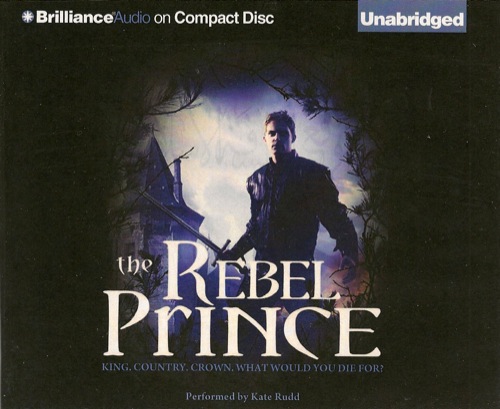
This audiobook asks: “King, Country, Crown. What would you die for?” Author Celine Kiernan is also, apparently, working on a graphic novel.
The Rebel Prince (book 3 in the Moorehawke Trilogy)
By Celine Kiernan; Read by Kate Rudd
11 CDs – Approx. 13 Hours [UNABRIDGED]
Publisher: Brilliance Audio
Published: October 18, 2010
ISBN: 9781441891679
Sample: |MP3| Wynter Moorehawke has braved bandits and Loup-Garous to find her way to Alberon — the exiled, rebel prince. But now that she’s there, she will learn firsthand that politics is a deadly mistress. With the king and his heir on the edge of war and alliances made with deadly enemies, the Kingdom is torn not just by civil war – but strife between the various factions as well. Wynter knows that no one has the answer to the problems that plague the Kingdom – and she knows that their differences will not just tear apart her friends – but the Kingdom as well.
This series has a very interesting premise. In Rachel Aaron’s universe all inanimate objects, in addition to people (and perhaps animals), have spirits. I’m not sure if there have been any Fantasy novels that have used animism before this one. Although, now that I think of it, I guess one could take it a step further and give even abstract nouns spirits as well – but that’s a different zeitgeist altogether.
The Spirit Rebellion: The Legend of Eli Monpress, Book 2
By Rachel Aaron; Read by Luke Daniels
10 CDs – Approx. 12 Hours [UNABRIDGED]
Publisher: Brilliance Audio
Published: November 1, 2010
ISBN: 9781441886576
Sample: |MP3| Eli Monpress is brilliant. He’s incorrigible. And he’s a thief. He’s also still at large, which drives Miranda Lyonette crazy. While she’s been kicked out of the Spirit Court, Eli’s had plenty of time to plan his next adventure. But now the tables have turned, because Miranda has a new job — and an opportunity to capture a certain thief. Things are about to get exciting for Eli. He’s picked a winner for his newest heist. His target: the Duke of Gaol’s famous “thief-proof” citadel. Eli knows Gaol is a trap, but what’s life without challenges? Except the Duke is one of the wealthiest men in the world, a wizard who rules his duchy with an iron fist, and an obsessive perfectionist with only one hobby: Eli.
One tale, from this collection of Bruce Coville short stories, is available for FREE DOWNLOAD |HERE|.
Oddly Enough
By Bruce Coville; Read by various
4 CDs – Approx. 4 Hours [UNABRIDGED]
Publisher: Full Cast Audio
Published: October 2010
ISBN: 9781936223350
A collection of nine short stories about “vampires, werewolves, ghosts, unicorns.”
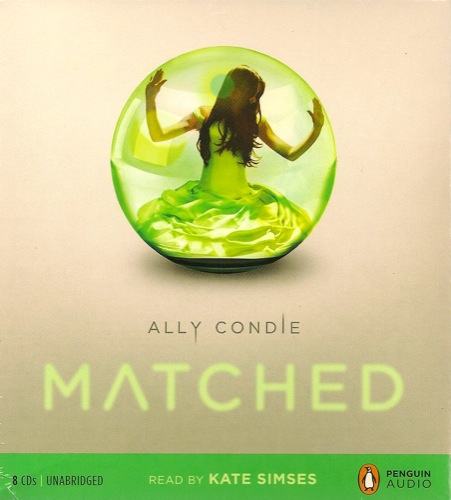
Here’s a new young adult novel, the first of three, set in a dystopian world in which boys and girls are matched by their society.
Matched
By Ally Condie; Read by Kate Simses
8 CDs – Approx. 10 Hours [UNABRIDGED]
Publisher: Penguin Audio
Published: November 30, 2010
ISBN: 9780142428634 Cassia has always trusted the Society to make the right choices for her. So when Xander’s face appears on-screen at her Matching ceremony, Cassia knows with complete certainty that he is her ideal mate … until she sees Ky Markham’s face.
Though Margaret Atwood denies it, along with denying that humans landed on the Moon, I genuinely and truly believe she has written an excellent Science Fiction novel. In fact, BBC Radio 4’s production of that very Science Fiction novel, The Handmaid’s Tale, is truly excellent Science Fiction drama too! That’s why I’m so excited to pass along this post from Radio Drama Revival‘s Fred Greenhalgh:
Oh, dear listeners, today we have a treat for you! It’s a story commissioned by the the gold standard in audio drama – the BBC!
The show is producer John Dryden’s inspired adaptation of The Handmaid’s Tale, by Margaret Atwood. The story tells of a dismal future where the lines between church and state are no longer distinguishable, and the nature of femininity has been revised to fit a more religious bent.
Free young women are conscripted to become “handmaid’s” – women used as stand-ins for infertile wives in a world where sterility seems rampant… And this is the story of one of those Handmaids.
Part 1 is available now, parts 2 and 3 will appear in future podcasts…
A full-cast dramatization based on one of the 20th century’s most outstanding novels about the future. When religious extremists take over the US government, they create the Republic of Gilead where women are prohibited from owning property and all money is transferred to male relations.
The Iron Heel, one of the books from our 4th Annual SFFaudio Challenge. It is now complete and available free from LibriVox! Narrator Matt Soar sez:
I have just this afternoon finally finished the last chapter of Jack London’s The Iron Heel. Phew! It’s been quite an experience – begun in Montreal, completed in France, six months in the making.
He actually wrote that two months ago. See, Matt decided to make a planned creative commons release release PUBLIC DOMAIN! Woohoo! It’s on LibriVox and it has now been catalogued!
And, over in the “about” section of Matt’s site, TheIronHeel.net Matt wrote:
The entire experience has been intriguing, if not uncanny: The story, about an overbearing, immoral government characterized by deception, torture, and warmongering, against a background of civilian exploitation and religious zealotry, is mainly remarkable for the fact that it was written a hundred years ago — rather than, say, five.
Perhaps the only aspects of The Iron Heel that really age it are its breathlessly romantic heroine, occasionally prosaic language, and the author’s fleeting use of dubious terms to describe ethnic minorities. These quibbles aside, I’m really glad I took the time to record it, and hope you enjoy it too.
The Iron Heel
By Jack London; Read by Matt Soar 26 Zipped MP3 Files or Podcast – Approx. 8 Hours 18 Minutes [UNABRIDGED]
Publisher: LibriVox / TheIronHeel.net
Published: July 16, 2010 Generally considered to be the earliest of the modern dystopian novels, The Iron Heel chronicles the rise of an oligarchic tyranny in the United States. It is arguably the novel in which Jack London’s socialist views are most explicitly on display. A forerunner of “soft science fiction” novels and stories of the 1960s and 1970s, the book stresses future changes in society and politics while paying much less attention to technological changes.
WARNING: This review is a bit of an aberration, it’s a bit more gonzo. It was written this way out of necessity and it is thus perhaps only suitable for those who… ‘heard he was dead.’
Escape From New York
Based on the screenplay by John Carpenter and Nick Castle; Adapted by Bill Hollweg; Performed by a full cast
5 MP3 Files or Podcast – Approx. 2 Hours 15 Minutes [AUDIO DRAMA]
Podcaster: BrokenSea Audio Productions
Podcast: April 2009 – March 2010
Themes: / Crime / Dystopia / Science Fiction / Alternate History / WWIII / Prison / Horror / New York /
Part 1 |MP3| Part 2 |MP3| Part 3 |MP3| Part 4 |MP3| Part 5 |MP3|
In the year 1988 the crime rate in the United States rises 400%. The once great city of New York becomes the one maximum security prison for the entire country. A fifty foot containment wall is erected along the New Jersey shoreline, across the Harlem river, and down along the Brooklyn shoreline. It completely surrounds Manhattan Island. All bridges and waterways are mined. The United States Police Force, like an army, is encamped around the island. The prison’s name: New York Maximum Security Penitentiary, Manhattan Island. There are no guards inside the prison, only prisoners, and the worlds they have made. The year now… 1997.
In the opening crawl (detailed above) we are given a world rife with Science Fiction glory. Escape From New York has a premise full of promise. It is a story pregnant with possibilities – nearly all of which are fulfilled. Escape From New York, my friends, is both a powerful satire of our times and a powerful cinematic experience movie. Now, thanks to the creative love and attention by fans at BrokenSea Audio Productions it is a wondrous audio drama made by fans for fans.
Now hang with me on this. I hope I don’t end up seeming like a crazed french film critic, arguing for the superiority of the second Star Wars trilogy (The Phantom Menace et. al) over the original Star Wars and Empire. Take that first statistic: “the crime rate in the United States rises 400%” – how would that be possible? It certainly wouldn’t match any conventional trend or shift in population growth. Might it then be categorized under some sort of Freakonomics-style explanation? Maybe. But, I think we could argue, quite convincingly, that the only way to increase the crime rate 400% overnight would be to make a whole lot more human behaviors crimes. Disrespecting authority, sharing files with friends, or as the trailer for Escape From L.A. puts it “No talking, no smoking, no littering, no red meat, no freedom of religion. And remember all marriages must be approved by the Department of Health.” So, the world of Escape From New York is really fun. But a world is not enough. You need a plot and a set of characters. As to the latter…
The anti-hero takes many forms but I have a special fondness for Snake Plisken. As in an IMDB grendelkhan says:
“Snake Plissken is the classic anti-hero, ala Clint Eastwood’s Man-with-no-name. Plissken is an ex-soldier turned criminal, recruited/blackmailed into rescuing a hostage president from the prison of New York City. Plissken is a walking ball of anger and a survival machine.”
Indeed, a survival machine who’s been betrayed, lied to shat on by his own government – and he’s got a cool eye-patch, a reverse tramp stamp of a cobra, and a gravelly voice. He is a great character.
“But what of his motivation?” You ask.
Read on…
Plisken, call him Snake, lives in a parallel universe – a USA run like a fun-house-lensed double craptoberfest of moral hypocrisy. If you’ve seen the movie Escape From New York, you’re seeing the 1980 zeitgeist of Manhattan as the epitome of ghettoic urban decay. This fear, that your neighbors are out to get you, the horror that politicians so often rely upon, works great in movies (and in the opening credits to The Equalizer). But this isn’t only a horror story. The prison genre is one of my favorites (check out Animal Factory). Like westerns, these genre stories have a certain set of conventions or constraints that make a story told within those constraints far more satisfying. But neither is Escape From New York just a prison story. For it
is also a quest story, a revenge story, an all out action adventure. There are MacGuffins galore for Plisken to chase after: First up is a world peace conference that is about to end in disaster lest a certain audio cassette is retrieved, then there’s a kidnapped President Of The United States to be rescued, and of course there’s a jet glider (don’t think too hard about that one) as their only escape, but to top it all off there’s a pair of ticking time-bombs in Snake’s body! That’s not just motivation, that’s entertainment folks!
Snake, now motivated, has enough-knock-down-drag-out adventures in the course of just less than 24 hours, so as to numb any thoughy you had about suspending any disbelief. Or as Samuel Taylor Coleridge argued: “[if a writer could infuse a] human interest and a semblance of truth [into a fantastic tale, the reader would suspend judgment concerning the implausibility of the narrative].” If you look at it another way this is the original 24, but with a hard-assed biker veteran saving the USA instead of a Kiefer Sutherland. In the course of just over 2 hours Bill Hollweg and the folks at BSAP have created a faithful and loving tribute to one of 1981’s best movies.
Speaking of 1981, I look forward to hearing BSAP adapt Clash Of The Titans (1981), Excalibur (1981) and Body Heat (1981). They’re already working on a Mad Max II (1981)-inspired series.


 With A Little Help





 The Iron Heel, one of the books from our