Brad Meltzer AUDIBOOK promo video

SFFaudio News

Book Of Lies by Brad MeltzerThis video appeared in the Hachette Audio podcast feed. It’s a viral video trailer, of sorts, for an upcoming Brad Meltzer audiobook. It features Joss Whedon and Christopher Hitchens, among others – expounding upon or flatly denying the existence of an ancient conspiracy – likely found in the novel itself, The Book Of Lies, releases September 2nd 2008. Meltzer has a previous novel with a similar title, presumably this is the follow up. Check out the vid…

Here’s the podcast feed:

http://www.hachettebookgroupusa.com/features/rss/hbgusa_podcast.xml

Posted by Jesse Willis

New Releases – Lovecraft, Pohl, Williamson, del Rey, Smith

New Releases

[editor’s note-A slew of releases from my audiobook company, Wonder Audio.  A nice range of titles that I’m proud to present.  Vintage Stories+Classic Authors+Great Narrators=Massive Goodness :) ]

Preferred Risk tnPreferred Risk
By Frederik Pohl & Lester del Rey; Read by Mark Douglas Nelson
7 hrs. – [UNABRIDGED]
Publisher: Wonder Audio
Availiable at Audible and iTunes

The Company was a powerful, efficient, and monstrous insurance organization that controlled the entire world, scientifically regulating everything in life: war, epidemics, one-a-day food pills and test-tube sex…all through the use of its patented, terrifying human deep-freeze vault.

Claims Adjuster Wills, a great believer in the Company, begins to have second thoughts when he meets beautiful and sorrowful Rena, whose radical father lies in a frozen subterranean vault.

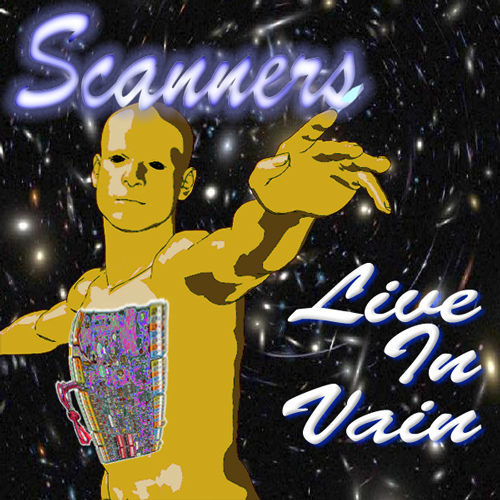
Scanners Live in Vain tnScanner Live in Vain
By Cordwainer Smith; Read by Jeremiah Costello
1.5 hrs. – [UNABRIDGED]
Publisher: Wonder Audio
Availiable at Audible and iTunes

Man has conquered space, but not without costs. To maintain the space lanes, Scanners have to undergo an operation in which their brain is severed from their sensory inputs to block the Pain of Space.

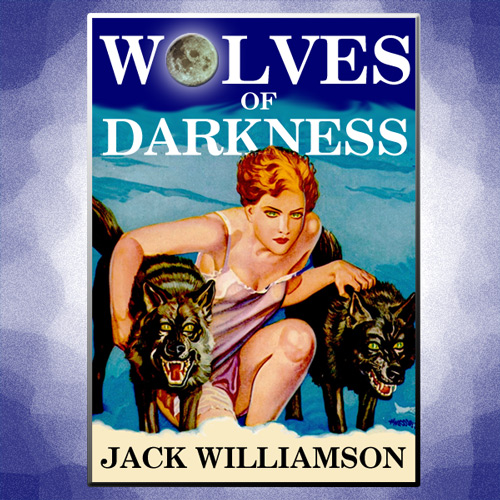
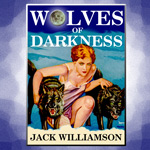
Wolves of Darkness tnWolves of Darkness
By Jack Williamson; Read by William Coon
3 hrs. – [UNABRIDGED] 
Publisher: Wonder Audio
Availiable at Audible and iTunes

When Clovis McLaurin receives an urgent letter from his father, Dr. Ford McLaurin, he rushes in the dead of winter to his father’s ranch. Clovis arrives to find the local townspeople being attacked and killed by a pack of wolves. As he journeys to the ranch of his father, a scientist who has been doing revolutionary experiments, he is also attacked.

But wolves are not the only thing running with the pack. Stella Jetton, the daughter of his father’s assistant, is running with the wolves, dressed in only a silk slip in the bitter cold. Clovis recognizes the blood-stained face of the girl he loves, but not her eyes. How could his father’s experiment have untapped the unimaginable horror that Clovis is about to confront?

The Colour Out of Space TNThe Colour Out of Space
by H.P. Lovecraft; read by Mark Douglas Nelson
1.5 hrs- [UNABRIDGED] 
Publisher: Wonder Audio
Availiable at Audible and iTunes

As a man surveys the countryside for the construction of a reservoir, he comes across a stretch of barren farmland leeched of life. An aged survivor of the town tells him the tale of a rural farmer’s family and their path to madness and unspeakable horror.

Lovecraft considered “The Colour Out of Space” to be the best of all his stories. Originally appearing in the September 1927 issue of Amazing Stories, it is one of his most frequently anthologized tales.

Posted by The Time Traveler of the Time Traveler Show

Review of Dr. Bloodmoney by Philip K. Dick

SFFaudio Review

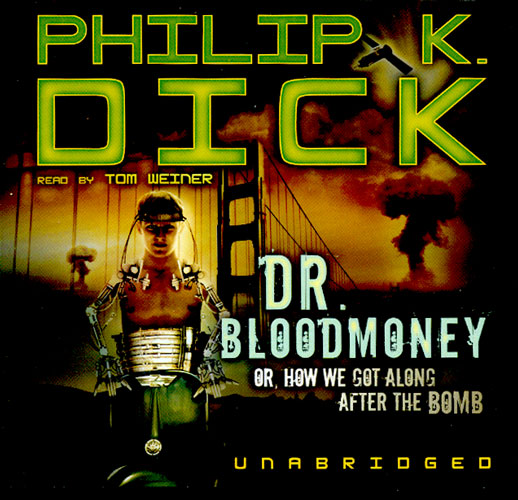
dr_bloodmoney150.jpgDr. Bloodmoney, or How We Got Along After the Bomb
By Philip K. Dick; Read by Tom Weiner
7 CD – 8.5 Hours [UNABRIDGED]
Publisher: Blackstone Audio
Published: 2008
ISBN: 9781433245503
Themes: / Science Fiction / Telepathy / Post Apocalypse / Nuclear War / Satellites / Psychokinesis / California /

Philip Dick’s post-nuclear-holocaust masterpiece presents a mesmerizing vision of a world transformed, where technology has reverted back to the nineteenth century, animals have developed speech and language, and humans must deal with both physical mutations and the psychological repercussions of the disaster they have caused. The book is filled with a host of Dick’s most memorable characters: Hoppy Harrington, a deformed mutant with telekinetic powers; Walt Dangerfield, a selfless disc jockey stranded in a satellite circling the globe; Dr. Bluthgeld, the megalomaniac physicist largely responsible for the decimated state of the world; and Stuart McConchie and Bonnie Keller, two unremarkable people bent the survival of goodness in a world devastated by evil. Epic and alluring, Dr. Bloodmoney brilliantly depicts Dick’s undying hope in humanity.

The subtitle, of Dr. Bloodmoney is or How We Got Along After the Bomb, the idea for it came from the original publisher (ACE Books) who wanted to capitalize on the subtitle of the movie Dr. Strangelove. I can almost see it too. For me, this wasn’t Philip K. dick’s best novel. But, if you liked his best novel, you’ll like this one. I did. The thing is, no matter which one of Dick’s novels is your favourite, Doctor Bloodmoney will remind you of it – if only for the author’s voice. Dick, more than with any other emotion, writes with sympathy. You feel for his characters, their petty goals, their yearnings, their little prejudices. The plot on this one is almost unimportant, it’s also hard to sum up in a sentence, but I’ll try: A radio repairman with no limbs (due to phocomelia) has superpowers, which he uses to predict/cause WWIII, then becomes ultra-powerful as a big fish in a small pond.

The rule about writing what you know is more difficult in Science Fiction. Nobody’s been to Mars yet. Nobody has met an alien. But you can clearly see what Dick knows showing up on the pages of his SF novels. When he wrote Dr. Bloodmoney he was really into Jungian and Freudian analysis, he was reading Of Human Bondage and was probably an avid mushroom picker. The plot doesn’t really matter as this is a situation with a set of Dickian characters. What stands out, what will remain in my memory are the scenes, characters interacting with each other and themselves. Thinking their thoughts, acting their acts. When we meet the title character, Bruno Bluthgeld, for the second time later in the book, (he’s not the star), he’s showing off his talking sheep dog to a little girl. She asks to hear the dog speak. It does, and the tears came to my eyes. When Stuart McConchie goes into San Fransisco he parks his horse only to come back and find it eaten by the city’s underclass. It really is all there: The salesmen, the repairmen, the cheating wives, the murderous children and the sympathetic animals. Everything we expect from a Dick tale.

Blackstone Audio narrator Tom Weiner is fast becoming a new favourite. His natural timbre is basso but he can do a lot with it. Performance is the key, everybody gets a voice of their own. In this novel that’s especially necessary as there are more than a dozen characters sharing the plot and dialogue. Blackstone has more Dick headed to audiobook too. The Man In The High Castle has already been released. Ubik is winging it’s way to us right now and Flow My Tears, The Policeman Said, Valis, The Three Stigmata of Palmer Eldritch should be released over the next few months. We are living in very Dickian times my friends.

Posted by Jesse Willis

Red Panda novel audiobook preview

SFFaudio Online Audio

Tales Of The Red Panda

Gregg Taylor of Decoder Ring Theater has recorded the first three chapters of his first Red Panda novel Tales of The Red Panda: The Crime Cabal! This isn’t audio drama, this is AUDIOBOOK! The print release is already available for pre-order, but I’m going to be lobbying hard for a full unabridged release. If that whole acting gig on RP doesn’t work out Taylor can begin an audiobook narrating career based on this sample alone. Check out the three chapter sneak peak audio version |MP3|.

Posted by Jesse Willis

LibriVox: The Land That Time Forgot by Edgar Rice Burroughs

SFFaudio Online Audio

LibriVoxReleased just yesterday, there’s a brand new audiobook in the ever expanding LibriVox catalogue that should draw many a happy ear. Edgar Rice Burrough’s The Land That Time Forgot follows in the long tradition of literature about myserious/lost/previously unknown areas of the Earth visited by regular folks who then write about it, put it in a bottle and then cast it into the sea. In reading The Land That Time Forgot you’ll feel its roots in Conan Doyle’s The Lost World, Poe’s The Narrative Of Arthur Gordon Pym and De Mille’s A Strange Manuscript Found In A Copper Cylinder.

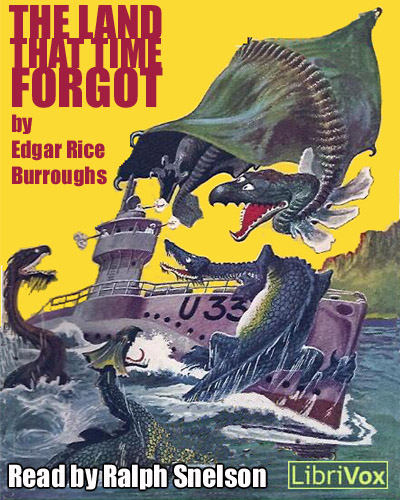
LibriVox Science Fiction Audiobook - The Land That Time Forgot by Edgar Rice BurroughsThe Land That Time Forgot
By Edgar Rice Burroughs; Read by Ralph Snelson
10 Zipped MP3s or Podcast -3 Hours 50 Minutes [UNABRIDGED]
Publisher: LibriVox.org
Published: August 2008
The Land That Time Forgot is a science fiction novel, the first of Edgar Rice Burroughs’ “Caspak” trilogy. His working title for the story was “The Lost U-Boat.” Starting out as a harrowing wartime sea adventure, the story ultimately develops into that of a fantastical lost world.

Podcast feed:

http://librivox.org/bookfeeds/the-land-that-time-forgot-by-edgar-rice-burroughs.xml

And, be sure to check out ore new EDGAR RICE BURROUGHS author page, which details as many Edgar Rice Burroughs audiobooks, audio dramas and podcasts as we could find.

Posted by Jesse Willis

Review of Hide and Seek by Jack Ketchum

SFFaudio Review

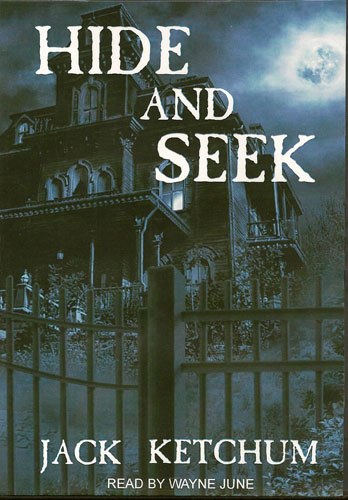
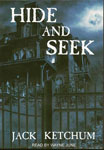
Horror Audiobooks - Hide and Seek by Jack KetchumHide and Seek
By Jack Ketchum; Read by Wayne June
5 CDs – 5.5 Hours – [UNABRIDGED]
Publisher: Audio Realms
ISBN: 9781897304402
Themes: / Horror /

Dead River’s a sleepy little town on the coast of Maine without much going for it. The Great Depression hit hard and never let go. Even now, sixty-odd years later, there’s not much to do, not much going on. So that when a trio of friends, rich college kids, arrive there on a forced march with their parents for summer vacation they have to make their own amusements. And they do, in spades.

So what scares horror writers? I imagine something like this: They draw back the curtain to provide the audience with a full look at their half-hidden ghosts, only to find that their readers react with indifference instead of terror at the final reveal.

This scenario has happened to me more than a few times during my reading experience, which is why I think that the old saw that horror writers “choose” not to write about vampires and zombies and ghouls because they’re “overused” and “cliche” is so much bullshit. Horror writers avoid these elements not because it’s hard to write about them, but because it’s hard to write about them believeably.

Jack Ketchum’s 1984 novel Hide and Seek unfortunately suffers a bit from this malady. Although its monsters are not truly supernatural, Ketchum’s novel contains a beast that really isn’t very scary, and its appearance towards the end of the book is a bit of a letdown–at least from my point of view.

Of course, it’s only a letdown because the buildup to that point is so damned compelling.

Hide and Seek is set in Dead River, a sleepy, depressed tourist town on the coast of Maine, and follows the story of a 20-year-old townie, Dan Thomas. Dan is living a life of inertia (“A tired life breeds tired decisions,” Ketchum writes), but the arrival of Casey, Kim, and Steve, three rich teenagers vacationing with their parents for the summer, shakes up his routine. Although he’s from a very different background, Dan is drawn to Casey, a beautiful but cynical and wild girl with a volatile, dangerous streak in her. She returns his affections and Dan becomes an accepted part of the group.
The teens like to get their kicks by breaking the rules–skinny dipping and petty thievery, mostly. So when Dan tells them about the old Crouch residence–an abandoned coastal house with a grim past that includes rumors of a cannibalistic couple and a pack of wild dogs–the lure is too much to resist. Casey suggests a game of grown up hide and seek without flashlights at night in the house, and the fun (and horror) ensues.

I’ll try not to spoil anything, but suffice to say that Hide and Seek has much more going on under the surface than a teenage slasher or haunted house movie. Hide and Seek is about the darkness we have inside of us. In a play on the title, Casey has her own dark secret that she keeps buried and hidden. Seeking it out at its dark core proves very dangerous, indeed.

The old Crouch house contains a tunnel of horrors in its dusty basement. Read as a symbol, the journey into this dark and rotten place is a voyage inside Casey’s bleeding psyche. A horrible, vile truth lurks in this void, but it must be faced and stamped out if she is to become whole.

Hide and Seek begins with a brief meditation on how fate and chance are unpredictable, and how even a single, awful event can twist and ruin someone for the rest of their life. For Casey, a moment of unforgiveable weakness by her father in her 13th year causes her to develop a wild, nihilistic streak that threatens to consume her. Only when she finally faces her fear–the beast in the cave–does Casey grow up:

In the midst of all the terror, we were happy. The caves had shown us the worst the world could do to you. And for just a moment, something of the best.

But Ketchum is not a typical writer and happy outcomes are not guaranteed. His horrors–and those endured by Casey–are mean and nasty, and can kill.

In summary, if viewed in a purely psychological sense, Hide and Seek works and its implications are frightening. But with a literal reading in the cold light of day, the things in the Crouch house aren’t really so frightening, after all.

Hide and Seek is read by Wayne June, and although I’ve said it before I’ll say it again: The guy has a voice made for horror. He’s not only dark and creepy sounding, but he imbues the text with passion. June is quickly becoming the “George Guidall” of horror.

Note: Hide and Seek is Ketchum’s second novel and, although I still recommend it as a cracking good read, his later stuff (The Lost, The Girl Next Door) gets better.

Posted by Brian Murphy